
Two-thirds of your team is already using AI they believe they’re not allowed to use — and the instinct to ban it is the one move that makes it more dangerous, not less. Don’t write the six-month policy and don’t send the “no ChatGPT” memo. Run a one-week sprint instead: classify your data, map each tier to which tools may touch it, ship a one-page policy people will actually read, and give everyone a sanctioned tool. The goal isn’t abstinence. It’s being able to see what’s happening.
Should you ban employees from using AI at work?
No. A ban doesn’t end the behavior — it hides it. After an organizational ban, roughly half of employees say they’d keep using personal AI accounts anyway (MindStudio, 2026). So the tool doesn’t disappear; it just moves to a personal login, off your network, paid on an expense report. You’ve traded a problem you could see for one you can’t.
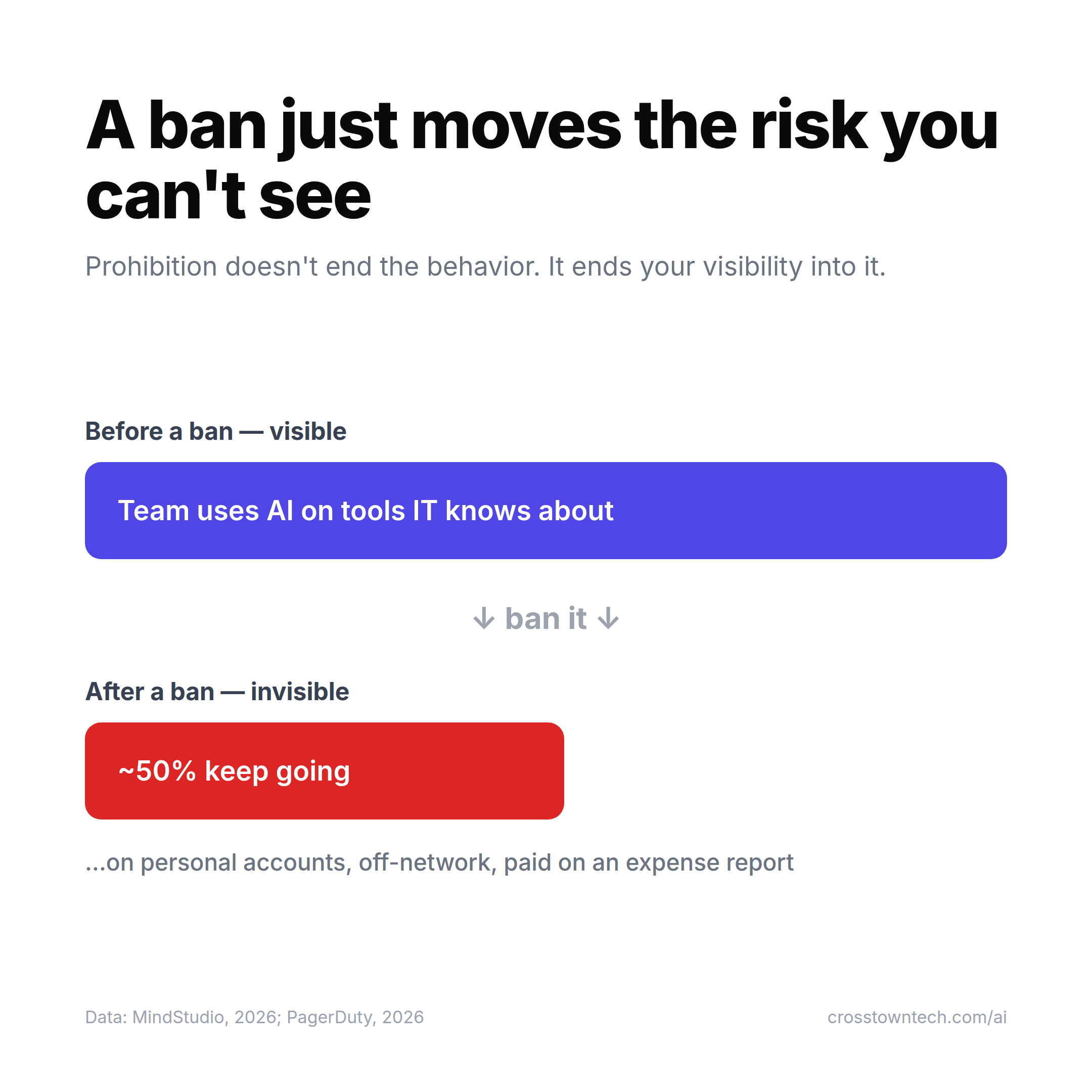
That’s the whole trap. Prohibition feels like control, but all it controls is your visibility. The usage keeps happening one layer below where any of your tooling can watch it.
How big is the shadow-AI problem, really?
Bigger than your dashboards show, because most of it is happening where you can’t measure it. 66% of office professionals have used AI at work despite believing it wasn’t permitted under company policy (PagerDuty, 2026). And the data is walking out through copy-paste: 77% of employees paste data into GenAI tools, more than half of those pastes contain corporate information, and 82% of them happen through unmanaged personal accounts that skip enterprise controls entirely (Cyberhaven, 2026).
This isn’t a fringe of rule-breakers. It’s most of the company, and the execs are often the worst offenders. Treating it as a discipline problem misreads it — people reach for these tools because they help, and no policy has told them how to do it safely. Read the other way, that’s your automation pipeline showing up uninvited: the people quietly using AI already know which jobs are worth automating.
Why does governing beat banning?
Because the risk was never AI use — it’s ungoverned use, and governance is how you make it observable. Look at what actually goes wrong when it goes wrong: in IBM’s 2025 report, shadow AI was involved in 1 in 5 data breaches and added about $670K to the average breach. Among the organizations that got breached through AI, 97% had no AI access controls and 63% had no AI governance policy at all (IBM, 2025; Cybersecurity Dive, 2026).
Read those two numbers together. The breaches didn’t happen because employees used AI. They happened because nobody had drawn a line around which data could go into which tool. Give people a sanctioned path and simple rules, and the easy path becomes the safe one — you get to keep the productivity and see what’s flowing where. Making that sanctioned tool genuinely better than the personal account is a wiring problem, not a policy one: see The Context Stack for the three ways to get company data behind it.
The one-week shadow-AI governance sprint
You don’t need a committee or a quarter. Here’s the week:
- Days 1–2 — Inventory and classify your data. List the AI tools already in use, shadow ones included (ask people; they’ll tell you if you’re not threatening to fire them). Then sort your data into four standard tiers: Public, Internal, Confidential, Restricted. This is the boring backbone every real policy sits on.
- Day 3 — Define approved tool tiers. For each tool, decide its lane: approved-enterprise (SSO, no training on your data), approved-with-limits, personal-consumer, or prohibited. Now you have two axes that fit together.
- Day 4 — Write the data-tier × tool matrix and the one-page policy. The matrix is the artifact people will actually use: which data tier is allowed in which tool tier — allow, limit, or prohibit — in one glance. Then the policy (below).
- Day 5 — Roll out and collect acknowledgement. Ship the sanctioned tool, publish the one-pager, get people to click “I read this.” Then set a monthly review — not a standing governance board.
Five days, and shadow AI becomes visible AI. The framework here is deliberately conventional — four data tiers, an approved-tools list, an owner (Nudge Security, 2026). The work is running it in a week instead of burying it in a 40-page document nobody opens.
What goes in the one-page policy?
Six parts, one page, written to be read:
- Scope — who and what it covers.
- Approved tools — the list, plus how to request adding one.
- Data rules per tier — what’s allowed in what, straight off the matrix.
- Prohibited uses — the short list of hard nos (client PII in a personal account, etc.).
- Accountability and reporting — who owns it, and how to report a mistake without getting punished for honesty.
- Review cadence — monthly, so it stays alive.
If it runs longer than a page, people skim it and default back to habit. The point of a policy nobody reads is zero.
What does “good” look like after a week?
A named owner, an approved tool everyone can reach, a matrix people understand, and shadow AI that’s now just AI you can see. Not perfect — visible. That’s the win, and it’s why the regulator is heading the same direction: Gartner expects that by 2030 more than 40% of organizations will hit a security or compliance incident tied to unsanctioned AI, and the EU AI Act (in force in 2026) already asks for governance documentation — a written acceptable-use policy is part of clearing that bar (Cybersecurity Dive, 2026).
FAQ
Should companies ban employees from using AI tools? No. Bans don’t stop usage — about half of employees keep using personal AI accounts after a ban (MindStudio, 2026). Prohibition just moves the activity off your network where you can’t govern it. Sanction a tool and set rules instead.
What is shadow AI and why is it a risk? Shadow AI is employees using AI tools your organization hasn’t approved. The risk isn’t the AI — it’s that ungoverned use is invisible: shadow AI was in 1 in 5 breaches in 2025, and 97% of AI-breached orgs had no access controls (IBM, 2025).
How do you write a shadow-AI policy? Classify data into four tiers (Public, Internal, Confidential, Restricted), map each to approved/limited/prohibited tools in a matrix, then write a one-page policy: scope, approved tools, data rules, prohibited uses, accountability, and a review cadence. You can do it in a week.
Can you govern shadow AI without buying a security tool? Yes. The first, highest-leverage step is organizational — data tiers, a tool matrix, a one-page policy, and one sanctioned tool. Detection software helps later, but most of the risk comes from having no rules at all, not from lacking a scanner.
Don’t write the 40-page policy. Run the week. Inventory what’s already in use tomorrow, classify your data by Friday, and put a sanctioned tool in front of people so the safe path is also the easy one. The hard part was never the policy — it’s making the approved tool the one people actually reach for.
I write one of these a week on making AI actually work inside companies — governed, not banned.