
Most AI automation roadmaps have one thing in common: nobody asked the person doing the work. A committee picks the use cases, IT scopes them, a slide deck ranks them by “impact,” and six months later three of the twelve have shipped. Meanwhile the person who actually runs the invoicing already knows which four hours of their week are pure copy-paste — and nobody asked.
That’s the whole problem with automating from the top. The use cases don’t live in a strategy deck. They live with the individual doing the task, and the fastest way to find them is to let that person go build.
Why do top-down automation programs stall?
Because a memo doesn’t change how anyone works. “Memos, mandates, and other top-down change efforts don’t, by themselves, change how people work” — AI adoption spreads peer-to-peer, when someone watches a trusted colleague use it on a real task (Harvard Business Review, Peer Influence Can Make or Break Your AI Rollout, Mar 2026). Leadership announces the strategy, blesses a tool, declares victory at the all-hands — and then wonders why usage flatlines.
The initiative was never the missing piece. It’s already there: 46% of automation projects are now started inside business units, not IT (ToolJet, Low-Code Statistics 2026). There are roughly 16.2 million citizen developers worldwide, up 38% in a year — people automating their own work with no roadmap and no permission slip. Cisco’s CIO Fletcher Previn names the two forces that have to meet in the middle: “the bottom-up inertia of people asking for access to tools, and the top-down inertia of saying, ‘here’s how we see this role evolving’” (Fortune, Aug 2025). Most companies over-invest in the top and starve the bottom.
What actually caps bottom-up automation?
Fear. 40% of employees now fear AI will take their job — up from 28% in 2024 (Mercer, Global Talent Trends 2026). That number is the ceiling on every enablement plan you’ll ever write.
Think it through from the doer’s chair. You’re good at your job. Half of it is repetitive. If you automate that half, the honest math in your head isn’t “I’ll get promoted” — it’s “I just showed everyone that half my role is a script.” So you don’t. You keep doing it by hand, badly, late, and the automation that would’ve saved the company a day a week never gets built. You cannot get someone to automate the job they’re scared of losing. That’s not a tooling problem or a training problem. It’s a safety problem, and it’s leadership’s to fix.
The four-move enablement playbook
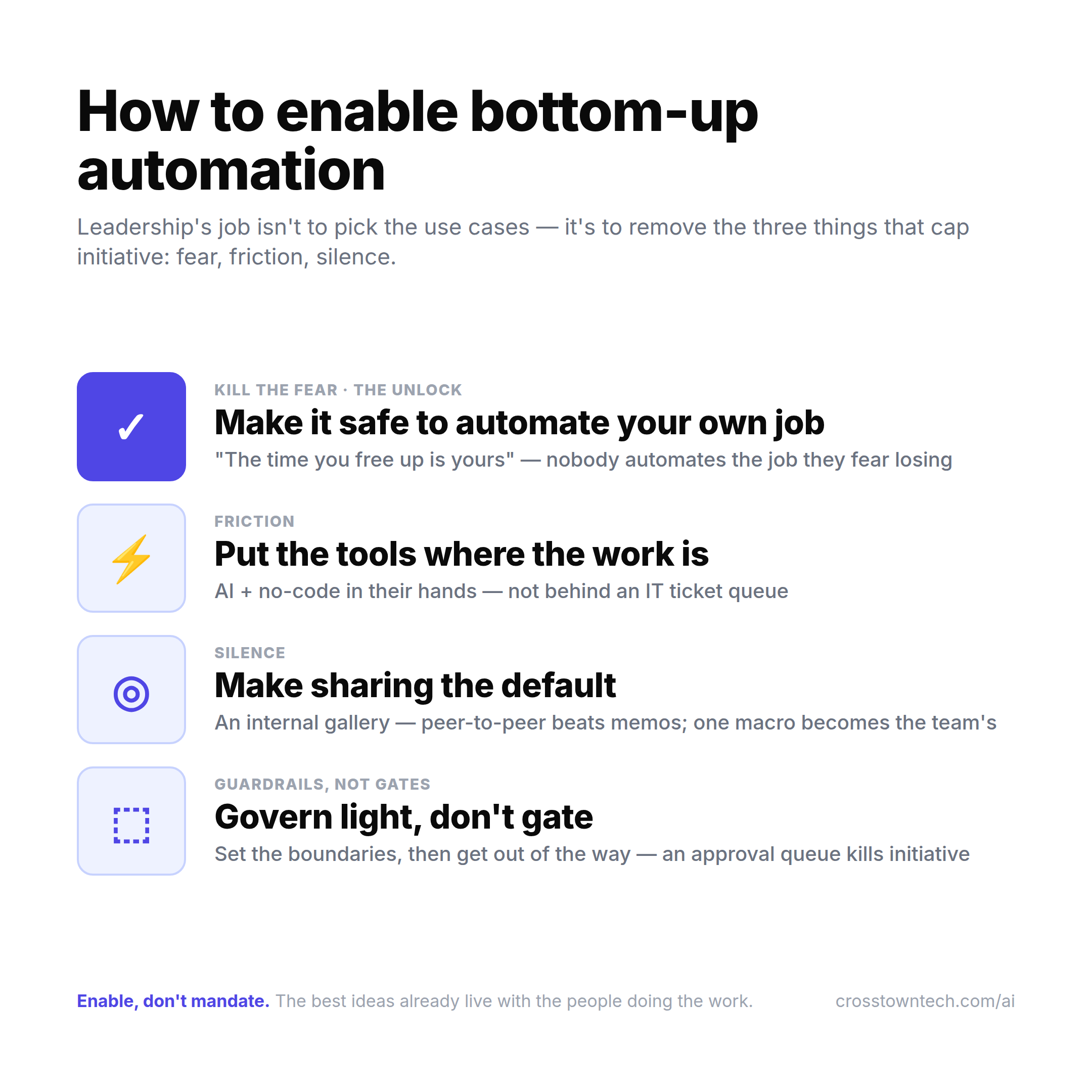
Leadership’s job isn’t to pick the use cases. It’s to remove the three things capping initiative — fear, friction, and silence — in this order.
1. Make it safe to automate your own job. This is the unlock, not the last step. Say the quiet part out loud: the time you free up is yours to reinvest, not a headcount target. Reward the person who automated themselves out of drudgery — publicly, in front of their peers — instead of quietly reassigning the “saved” hours. Previn calls it creating “emotional safety for people to innovate, experiment, and fail fast.” Until 40% of your people believe automating won’t cost them their seat, your best ideas stay in their heads. (This is the flip side of a point I made in “Claude quietly replaced the office manager I couldn’t afford” — for most teams AI fills a seat you never staffed, it isn’t the layoff.)
2. Put the tools where the work is. The 46% already building outside IT aren’t waiting for a ticket queue, so stop routing them through one. Give people AI and low/no-code in their own hands, on the real work. A three-week wait for provisioning is where initiative goes to die — the person had the idea on Monday and lost the itch by Friday.
3. Make sharing the default. This is the multiplier. Peer-to-peer beats memos, so build the channel for it: an internal gallery, a Slack channel, a monthly show-and-tell where people demo the small thing they wired up. One person’s invoice-chaser becomes the whole team’s. Without this, every automation is a private hack that dies when its author changes teams; with it, one good idea compounds across the org.
4. Govern light — don’t gate. Set guardrails, not approval queues. Which data can go where, which actions need a human sign-off, what’s off-limits — publish it once, then get out of the way. An approval committee in front of every automation quietly re-imposes the top-down bottleneck you were trying to escape. This is the same move as not banning shadow AI but governing it: a clear boundary people can act inside beats a gate they route around.
What does “good” look like in 90 days?
Not one big IT project shipping. A gallery full of small ones — a dozen people who each automated a slice of their own week and showed someone else how. The metric isn’t “automations delivered by the platform team.” It’s “how many people who’d never automated anything built their first thing this quarter, and how many copied a colleague’s.” When automation is spreading peer-to-peer instead of being handed down, you’ve built the flywheel. The roadmap writes itself, from the bottom.
FAQ
Isn’t bottom-up automation just shadow IT with a nicer name? Only if you skip move four. Shadow IT is what happens when people build in the dark because there’s no sanctioned path. Light governance — clear guardrails on data and actions — turns the same energy into sanctioned, visible work. You’re not choosing between control and initiative; you’re choosing where to put the boundary.
How do we stop everyone from building fragile, one-off automations? You don’t stop it — you make it visible (move three) so the good ones get adopted and hardened, and the fragile ones get spotted early. A shared gallery is also your review surface. The failure mode isn’t too many small automations; it’s a hundred private ones nobody can see.
Where do we start if fear is high? Start with move one and a single team. Pick a group, tell them plainly that freed-up time is theirs to reinvest, and celebrate the first person who automates part of their own role. Safety is contagious the same way fear is — through peers, not memos.
If you only take one thing from this: stop writing the automation roadmap and start removing the three caps. Name one team this week, tell them the time they save is theirs, and put the tools in their hands. The ideas are already there — you just have to make it safe to use them.