
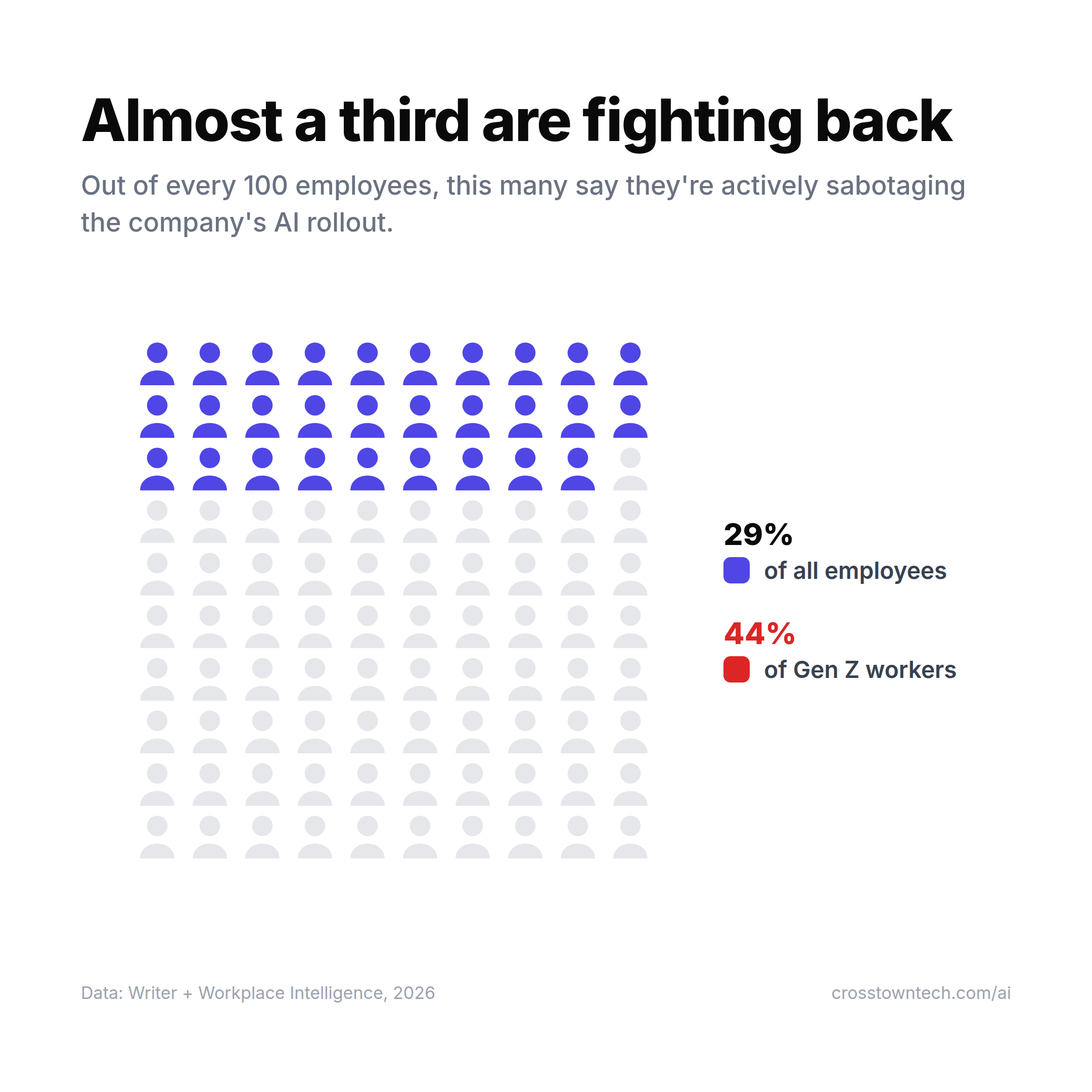
29% of employees admit they’re actively sabotaging their company’s AI rollout — 44% of Gen Z (Writer + Workplace Intelligence, April 2026). That’s not a training problem. It’s what happens when you tell people “use this or else” and skip every step in between. The mandate doesn’t produce adoption. It produces reactance — and the tell is that the executives writing the mandate use AI less than the employees they’re mandating it to.
What happens when you tell people “use AI or else”?
They don’t quietly comply. Some of them work against you. Sabotage here isn’t dramatic — it’s shadow AI on personal accounts instead of the sanctioned tool, faking usage while doing the work by hand, or quietly producing worse output so the rollout looks like it isn’t working. 29% of employees admit to some version of this, and it climbs to 44% among Gen Z — the group most companies are leaning on hardest to drive adoption. Separately, 45% of CEOs already see it: they say most of their own employees are resistant or openly hostile to AI (Kyndryl, May 2025). Leadership isn’t blind to this. It’s just responding with a bigger mandate instead of a different one.
Why does a mandate backfire instead of just working?
Because taking away a choice makes people want the removed option more, not less. That’s the basic mechanism: mandate an innovation, and the thing you’re replacing gets more appealing while the thing you’re forcing gets less appealing — the person resolves the discomfort by resisting, not by complying quietly. This isn’t a theory about how people might react. A 2026 study tracked 366 employees at a retail chain under a mandatory AI rollout and found the mandate directly drove innovation resistance, which fed job dissatisfaction, which fed three flavors of workplace complaint — some constructive, some just venting, some outright malicious (Yang & Hsu, Journal of Retailing and Consumer Services, 2026). The rollout didn’t fail because the tool was bad. It failed because “mandatory” was the whole strategy.
What’s actually being threatened isn’t the workflow — it’s identity
A mandate says “use this tool.” Employees hear something much bigger. Researchers at Wharton, Boston University, and European University Viadrina name three needs that get frustrated by a heavy-handed AI rollout: competence (am I still good at this job, or did the definition just change under me), autonomy (do I still control how I work), and relatedness (does this change how my team works together) — and their finding is blunt: “when those needs are frustrated, resistance is predictable” (Wharton Knowledge, April 2026). That’s the identity-grief part nobody budgets for in a rollout plan. A senior person who spent 15 years getting good at a skill isn’t being asked to adopt a tool — they’re being told, implicitly, that the thing they got good at matters less now. Nobody puts that on the rollout slide, but it’s what’s actually in the room.
The tell that the mandate isn’t really about the work
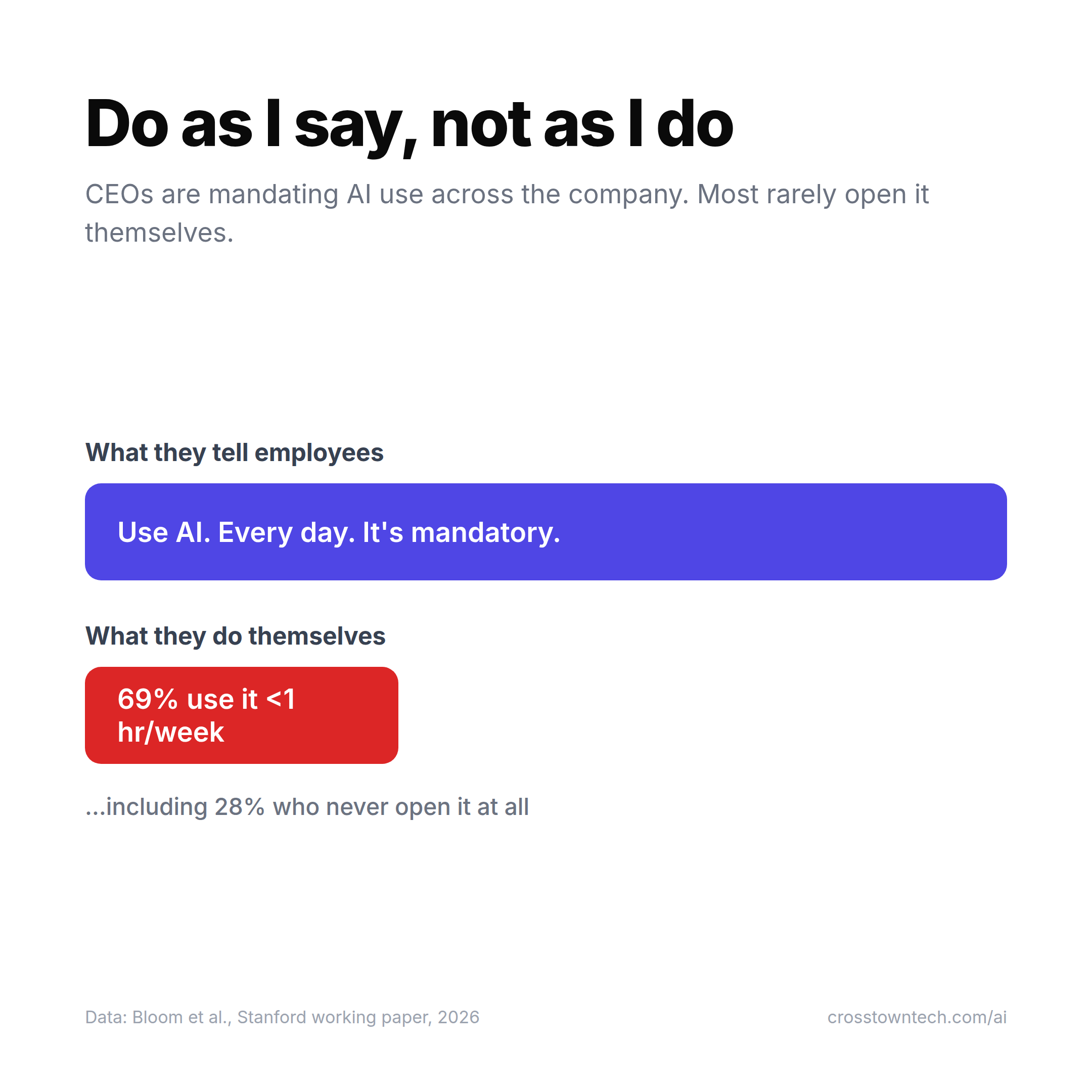
CEOs are telling employees AI use is mandatory. Most of them barely touch it themselves: roughly 69% of CEOs, CFOs, and senior executives use AI less than an hour a week — including 28% who never open it at all (Bloom et al., Stanford working paper, March 2026). That gap is corrosive in a specific way: a mandate from someone who visibly doesn’t use the thing reads as control, not conviction. Employees can tell the difference between “we believe this makes the work better, and here’s how we’re finding that out too” and “do this because I said so.” Reactance gets worse, not better, when the person enforcing the rule is exempt from it.
What actually reduces the resistance
Two moves, in order, from the same Wharton research: acknowledge, then empower. Acknowledge means naming the threat out loud instead of hoping nobody notices it — “this may feel like it’s redefining what expertise means,” “we don’t want this to feel imposed,” “this changes how we collaborate.” Say it before the mandate lands, not in a defensive Slack reply after the backlash starts. Empower means what it sounds like: give people a real decision in how the rollout happens, not just a login. Employees who help shape the implementation become co-creators. Employees handed a done deal become reluctant adopters at best — and at worst, part of the 29%. This isn’t a soft-skills nice-to-have; it’s the difference between a rollout that sticks and one that gets quietly sabotaged into irrelevance.
FAQ
Why do employees resist AI mandates? Because a mandate removes their choice, and removing choice triggers psychological reactance — people defend the option being taken away (not using AI) and devalue the one being forced on them. On top of that, the mandate usually threatens three things people need to feel okay at work: competence, autonomy, and relatedness.
How common is it for employees to resist or sabotage an AI mandate? 29% of employees admit to actively sabotaging their company’s AI strategy, rising to 44% among Gen Z (Writer + Workplace Intelligence, April 2026). Separately, 45% of CEOs say most of their employees are resistant or openly hostile to AI (Kyndryl, May 2025).
Does mandating AI use actually work? Not on its own. A 2026 study of 366 employees under a mandatory AI rollout found the mandate itself drove innovation resistance, which fed job dissatisfaction, which fed workplace complaints. The tool didn’t fail — the delivery did.
How do you reduce resistance to an AI mandate? Name the threat instead of pretending it isn’t there — say out loud that this changes what expertise means, that it isn’t meant to feel imposed, that it changes how the team works together. Then give people a real decision in how it rolls out, not just access to the tool. Acknowledge, then empower.
The one thing to try this week
Before your next AI rollout meeting, write down the specific competence, autonomy, or relatedness threat this change actually poses to the people in the room — not the generic one, the real one for that team. Say it out loud first, before anyone asks. Then give the team one genuine decision about how it ships — a pilot scope, a rollout order, an opt-in window — something you’ll actually let them change. That’s the whole difference between a mandate people route around and one they actually run with.
I write one of these a week on making AI actually work inside companies — the real workflows, the gaps, what’s hype.