
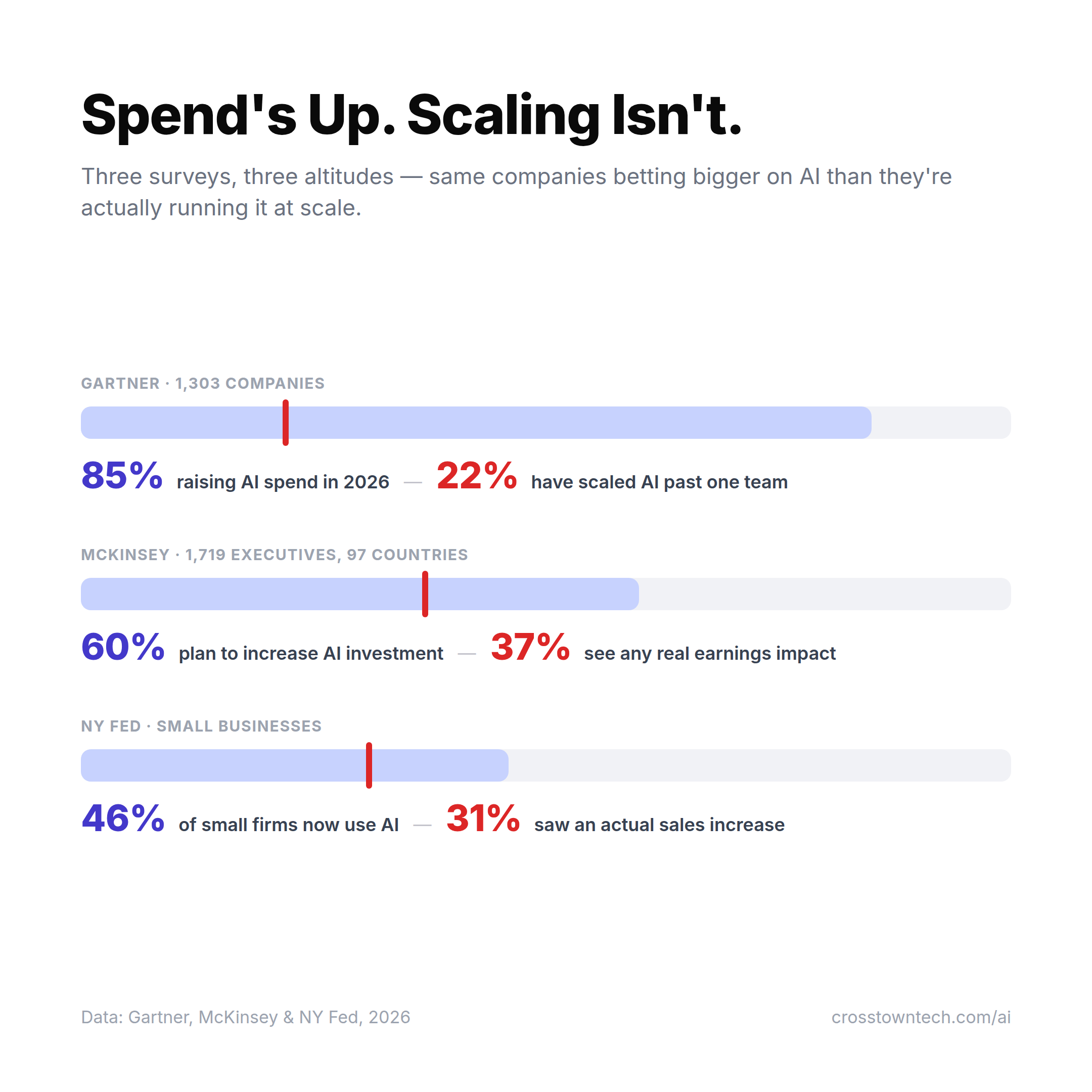
No — AI adoption isn’t failing. Adoption has never been higher: 85% of functional leaders are raising their AI budget in 2026 (Gartner, Sept 2026). What’s failing to keep up is depth — only 22% of those same companies have actually scaled AI past one team. Both numbers are true, from the same 1,303 companies. That’s not a contradiction. It’s the whole story.
Is AI adoption actually failing?
No. By every breadth measure — spend, pilots, who’s touched the tool — adoption is at an all-time high and still climbing. Gartner surveyed 1,303 organizations with at least $50 million in revenue between January and April 2026: those companies already put an average of 12% of their functional budget into AI in 2025, and 85% plan to spend even more in 2026 (Gartner).
McKinsey’s separate August 2026 survey of 1,719 executives across 97 countries found the same pattern at a different altitude: 60% expect their organization to increase AI investment over the next year (McKinsey, The State of AI, Aug 2026). If “adoption” means spend, headcount touching the tool, or pilots running, the honest answer is that it’s not slowing down anywhere.
Then why does it feel like AI isn’t working?
Because “adoption” and “it’s working” are two different claims, and most coverage treats them as one. In that same Gartner survey, only 22% of organizations have successfully scaled AI across more than one business unit — and 11% don’t even know what their own function spent on AI last year. McKinsey’s number lands in the same place from the earnings side: only 37% of executives can attribute any earnings impact to AI use at all — which means 63% can’t point to a single dollar of measurable return (McKinsey).
Spend scaled. Impact didn’t. That’s the gap, named plainly: breadth is how many people have access to the tool and how much money is flowing toward it. Depth is whether the actual workflow got redesigned around that tool — who does what differently now, what “done” means, what gets checked and by whom. Most companies bought the breadth. Almost none did the depth work, because redesigning a workflow is slower and less visible than approving a budget line.
What does the depth gap actually look like, day to day?
It looks like workslop — AI-generated output that reads as finished but isn’t, so the work doesn’t disappear, it just moves to whoever has to clean it up. BetterUp and Stanford’s Social Media Lab surveyed 1,150 full-time US desk workers in 2025 and found 40% had received workslop from a colleague in the past month — a report, a slide deck, a summary, or code that looked complete until someone actually tried to use it (BetterUp/Stanford, 2025; HBR, Sept 2025).
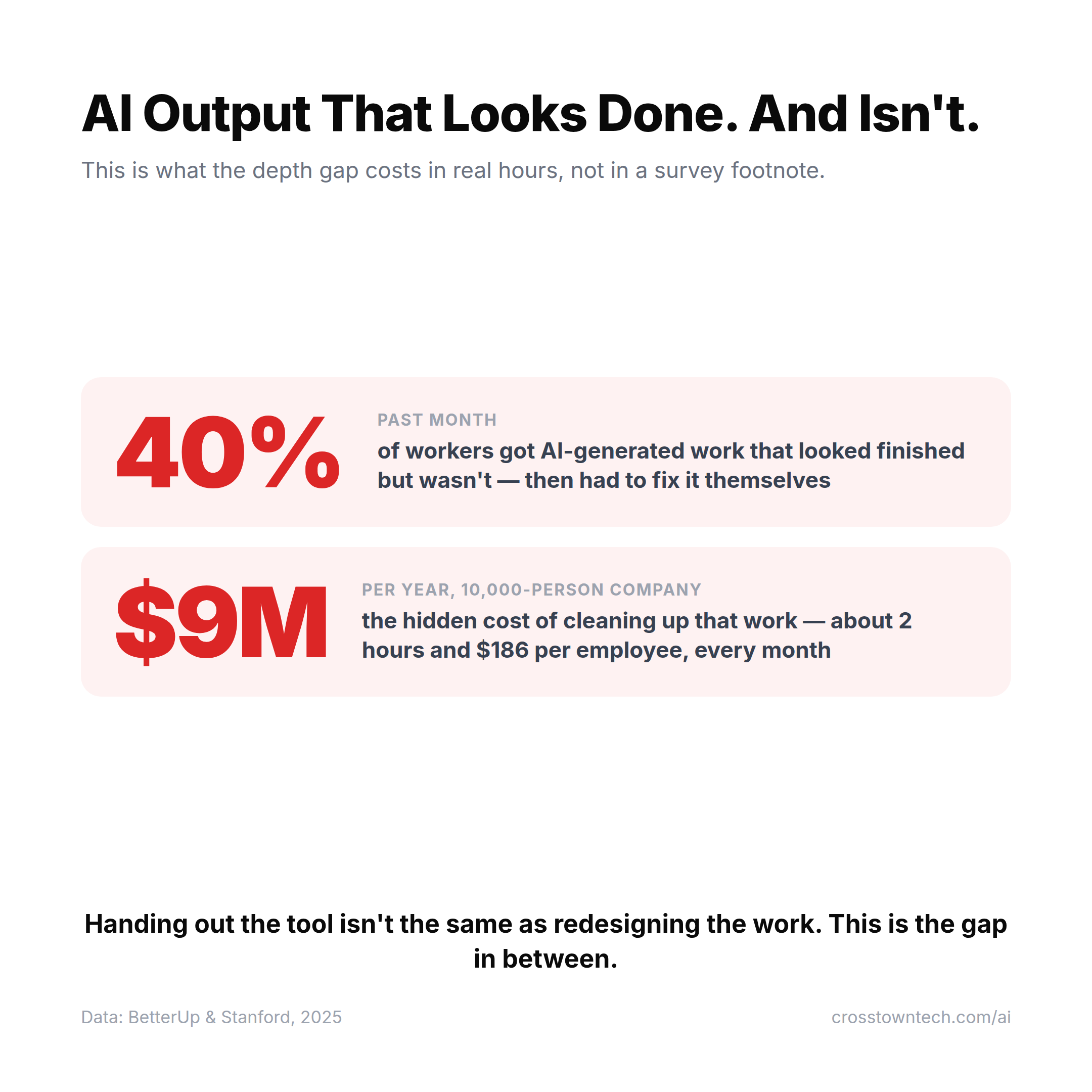
Each incident costs the recipient about 2 hours and $186 to fix, on average — which adds up to roughly $9 million a year for a 10,000-person company (BetterUp). That number is the depth gap made visible and priced. Nobody decided workslop was an acceptable outcome of adopting AI — it’s just what happens by default when access scales faster than anyone redefines what “done” looks like for the specific task. The tool went out. The job didn’t get redesigned around it. The gap between those two things is where workslop lives.
This is also why workslop isn’t evidence that AI “doesn’t work.” The same survey that measured it didn’t measure AI output in general — it measured output from a rollout with no workflow redesign behind it. A tool used inside a redesigned process and a tool bolted onto an unchanged one produce very different results from the same model.
Does this only happen at big, bureaucratic companies?
No — it’s the same shape at a completely different scale. The Federal Reserve Bank of New York published small-business AI data on October 8, 2026, drawn from the 2025 Small Business Credit Survey: 46% of small-employer firms already use AI for work, and another 15% plan to start within 12 months — real breadth, not just an enterprise phenomenon (NY Fed, Liberty Street Economics).
But among firms already using AI, 77% report no change in labor costs, and only 31% report an actual increase in sales from using it. The optimism shows up in expectations — AI users have a 33-point net-positive expectation gap on future employment and a 48-point gap on future revenue versus non-users — but the realized-outcomes column is thin. Small businesses don’t have the bureaucracy enterprises get blamed for, and they show the identical pattern: adoption moves first, results lag, because redesigning how the work actually gets done takes longer than turning the tool on.
So — is it breadth or depth that’s the real AI story in 2026?
Both, at once, inside the same companies. That’s the point most coverage misses by picking a side: “AI adoption is everywhere” (true) or “AI isn’t paying off” (also true) get reported as competing headlines when they’re the same finding measured two different ways. Gartner’s 85% and 22% aren’t from two different populations — they’re the same 1,303 companies. McKinsey’s 60% and 37% are the same 1,719 executives.
None of this is a verdict on whether AI works. It’s a verdict on sequencing: companies rolled out access before they redesigned the work, so the breadth number moved immediately and the depth number is lagging behind it by however long it takes to actually change how a workflow runs. That lag is normal for any new general-purpose tool — it’s just moving faster and getting measured more aggressively this time, which is why the gap is so visible in the data.
If you’re trying to close it rather than just name it: picking one real workflow and pushing it from “someone pastes into a chat window” to “it’s actually embedded in how the work gets done” is the adoption-stages problem. Proving that move actually paid off — instead of trusting a vibe — is the measuring AI ROI problem. Both are solvable. Neither gets solved by raising the budget line again.
FAQ
Is AI adoption actually failing in 2026? No — by every spend and usage measure, AI adoption is still climbing fast. 85% of functional leaders plan to raise AI spending in 2026 after already putting 12% of their budget into it in 2025 (Gartner). What’s failing to keep pace is depth: only 22% of organizations have scaled AI past a single team, and only 37% can point to any real earnings impact from it (McKinsey). Adoption and payoff are different claims, and most coverage conflates them.
What is “workslop” and why does it matter for AI adoption? Workslop is AI-generated work that looks finished but isn’t — a report, a summary, or code that reads as done until someone actually relies on it, then falls apart. 40% of US desk workers got workslop from a colleague in the past month, costing roughly 2 hours and $186 per employee to fix each time — about $9 million a year at a 10,000-person company (BetterUp/Stanford, 2025). It’s the clearest evidence that adoption outran workflow redesign: people got the tool before anyone decided what “done” means for the task.
Why do AI budgets keep growing if most companies don’t see AI ROI? Because spend and return are decided by different people on different timelines. Budget decisions get made on competitive pressure and the fear of falling behind; return takes 6–8 weeks to show up on a single, well-measured workflow and most companies never run that measurement. Gartner’s own survey found 11% of organizations don’t even know what they spent on AI last year — the spend keeps climbing because almost nobody is checking whether the earlier spend paid off.
Does the adoption-depth gap only affect large enterprises? No. The New York Fed’s October 2026 small-business survey found 46% of small-employer firms already use AI and another 15% plan to within a year — but only 31% of current users report an actual sales increase, and 77% see no change in labor costs. Same shape as the enterprise numbers, smaller stage: breadth moves first, results lag, at every company size.
Pick the one workflow your company actually cares about and ask two separate questions about it: did we give people the tool, and did we redesign the work around it? If the honest answer to the second question is no, that’s not AI failing — that’s the unfinished half of the job.
I write one of these a week on making AI actually work inside companies — the real gap, not the press-release version of it.