
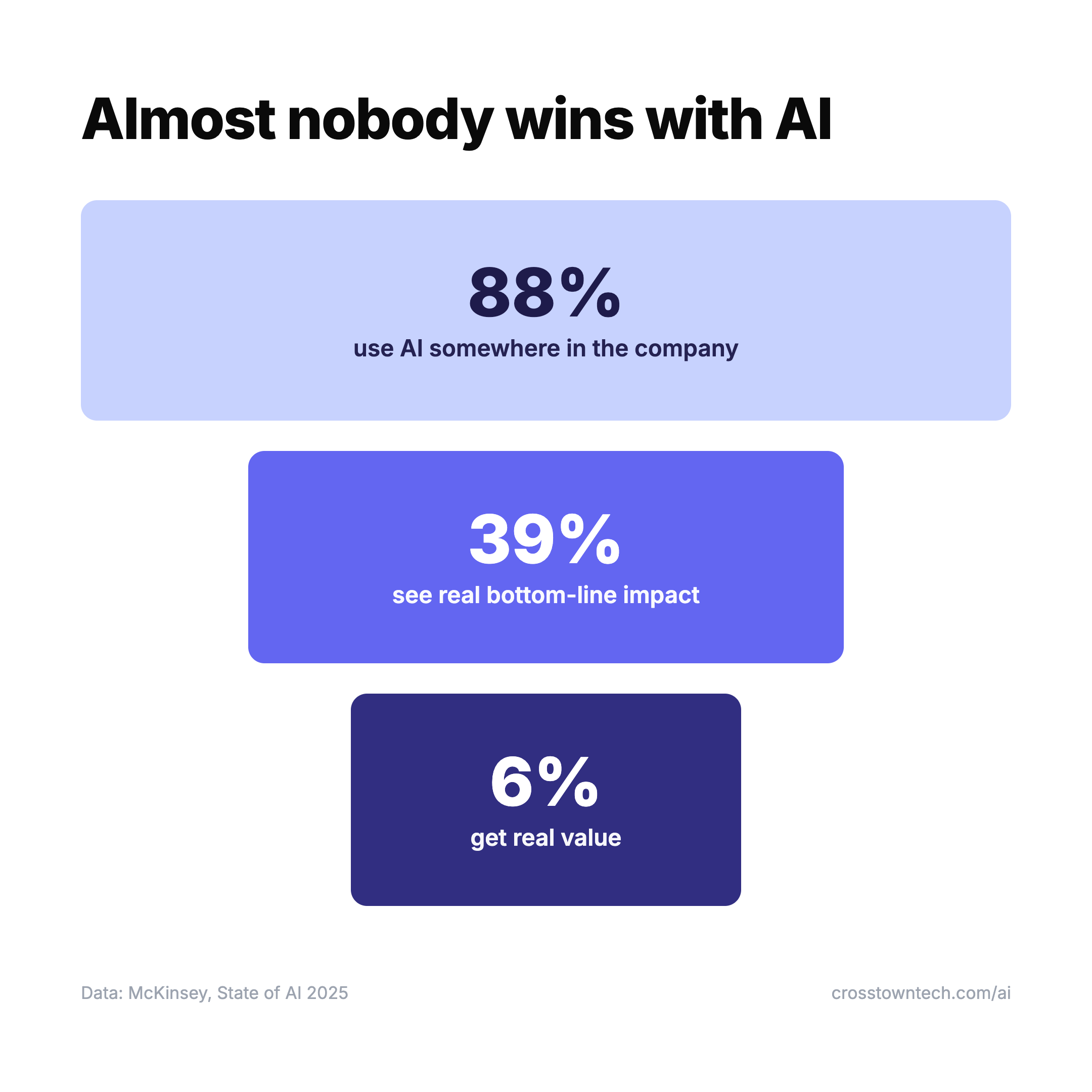
Almost everyone is using AI, and almost nobody is winning with it. 88% of companies now use AI in at least one function, but only 39% see any enterprise-level bottom-line impact — and just 6% count as real high performers (McKinsey, The State of AI, Nov 2025). MIT ran the numbers a different way and landed in the same place: 95% of enterprise GenAI pilots produced zero measurable P&L impact (MIT, The GenAI Divide, 2025).
Here’s the part everyone skips: the reason isn’t the models. MIT called it the learning gap — companies can’t get AI into their actual workflows, structure, and habits. So if your rollout feels stuck, you’re not behind on technology. You’re stuck at a stage — and almost everybody is stuck at the same one.
Why “what stage is our company at?” is the wrong question
No real company sits at one stage, so scoring the whole org on one line — “we’re a 3 out of 5” — tells you nothing you can act on.
A normal mid-sized company is barely experimenting in legal, running real pilots in marketing, and has engineering already shipping AI into production every day. That’s three different stages inside one building. Ask “what stage are we at?” and you get a useless average. Ask “which workflow is at which stage, and which one can move up next?” and you get something you can do something about.
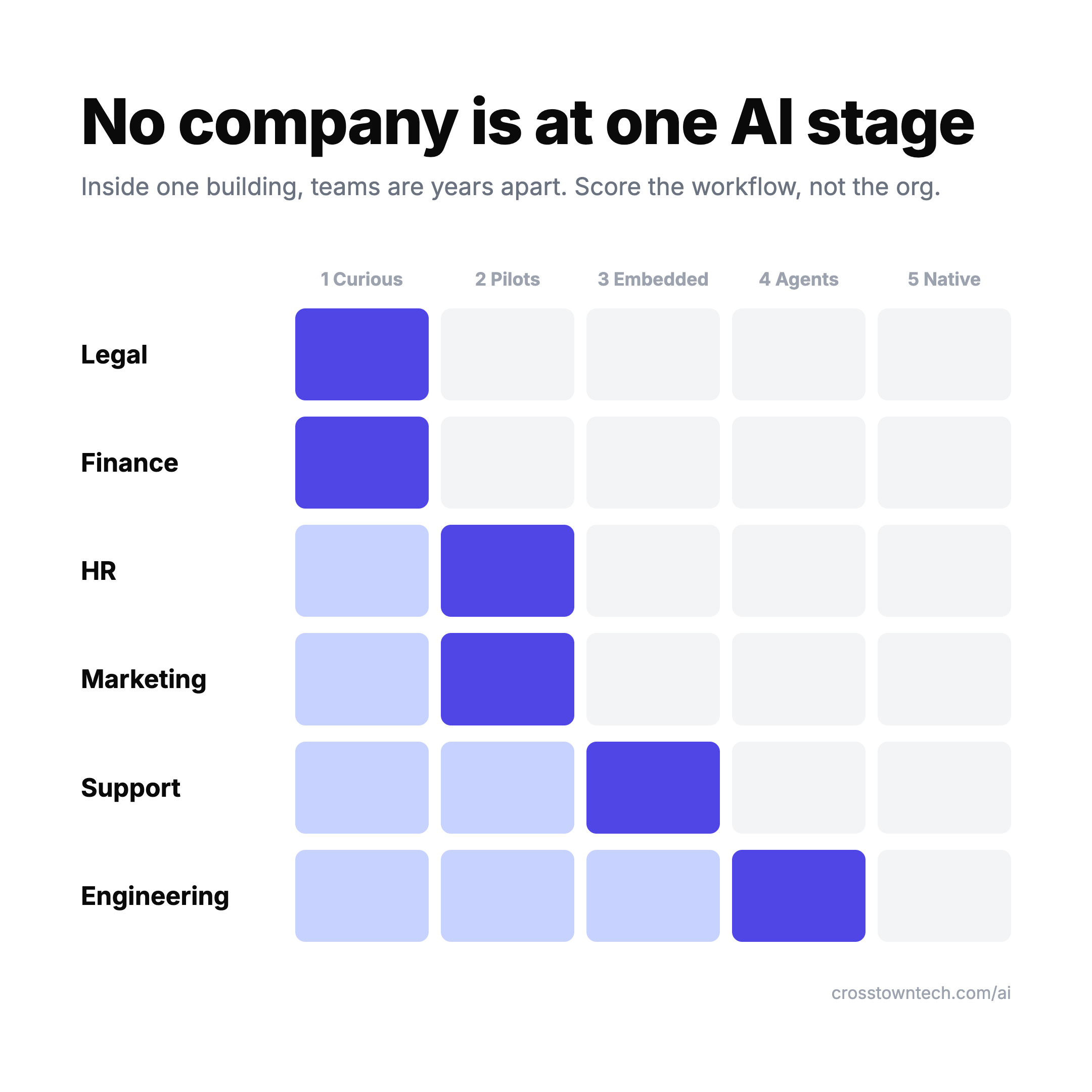
So the stages below describe a workflow, not a company. Point them at one process — invoice intake, customer replies, release notes, onboarding — and ask where that sits.
The five stages of AI adoption
Stage 1 — Curious. People use ChatGPT on their own. No strategy, and no one knows where AI is actually being used. Most of the company lives here, quietly, whether leadership knows it or not.
Stage 2 — Pilots. A few teams run their own experiments, each owned by a different person, mostly off-the-shelf tools, no shared platform. This looks like progress. It usually isn’t — see the next section.
Stage 3 — Embedded. AI sits inside a workflow that actually makes or saves money, wired into your real systems, with someone responsible for keeping it running. This is the first stage that shows up in the numbers.
Stage 4 — Agents on your data. Agents act with bounded autonomy on real company data. People move from doing the work to checking the work — on-the-loop instead of in-the-loop. Few companies have a single workflow here. Almost none have several.
Stage 5 — Agent-native. The process is designed around agents as the default doer, with humans handling exceptions and judgment. At a normal company this might be true for one function — usually engineering or support — and nothing else. Don’t let a vendor tell you it’s a whole-company state. It isn’t, anywhere, yet.
How do you know which stage a workflow is at?
Don’t read it off the tool. A team can pay for the fanciest agent platform on the market and still be at Stage 1. Read it off what actually happens when the work gets done. Pick one workflow and check it against these tells:
- Curious — someone pastes into ChatGPT and copies the answer back by hand. Nothing is wired in, nobody owns it, and if that person left tomorrow the “AI” leaves with them.
- Pilots — there’s a named experiment with a champion, but it lives beside the real workflow, not inside it. A human still re-checks and re-enters the output every time. Switch the tool off and the job runs exactly as it did before.
- Embedded — AI is a step the workflow can’t skip. It reads and writes your real systems, someone is on the hook when it breaks, and it moves a number you’d actually report — hours saved, tickets closed, cost cut. (If you can’t name that number, you’re not here yet — pick the metric before you scale.)
- Agents on your data — the agent takes the action, not just drafts it, on live company data with real permissions, out of a workspace that can reach your systems of record. The human moved from doing the work to approving it, and there’s an audit trail of what the agent did.
- Agent-native — the agent is the default doer and humans only touch the exceptions. If this is genuinely true for you, it’s true for one function — probably engineering or support — not the company.
Two honesty checks that catch most self-scoring mistakes. First: if a human still re-keys the output, you’re one stage lower than it feels — a slick demo is not Stage 3. Second: if you can’t say who gets paged when it breaks, it isn’t Embedded — it’s a pilot wearing a production badge.
Where companies actually stall
Look at Stage 2 and Stage 3. The distance between them is where almost everything dies. Gartner calls the space between a working pilot and a production system the valley of death, and McKinsey’s split says it plainly: lots of companies have adopted AI, far fewer have scaled it — nearly two-thirds haven’t begun scaling at all (McKinsey, Nov 2025).
In 2026 the gap just moved up a level. Everyone is adopting agents — but adopting and running in production are not the same thing. Roughly four in five enterprises have brought in AI agents; only about one in nine actually run them in production (Deloitte, State of AI in the Enterprise 2026). A separate read lands the same way: about 88% of agent pilots never graduate to production, with evaluation gaps, governance friction, and model reliability cited as the top blockers (Forrester/Anaconda, via Digital Applied, Apr 2026). It’s the same pilot-to-production chasm, one stage higher. Agents are scaling faster than the guardrails around them.
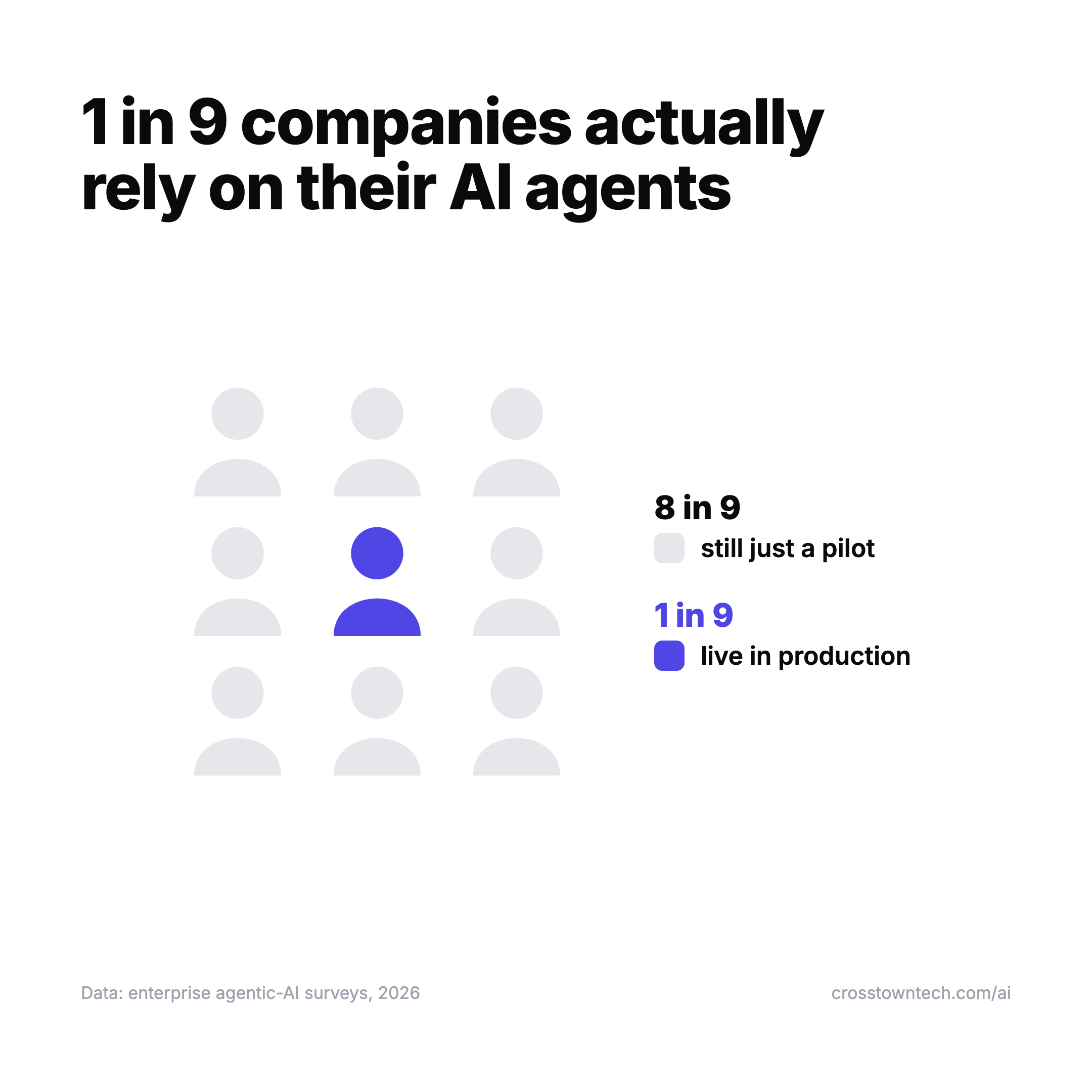
If you take one thing from this: a pilot that runs for a year is not Stage 2 progress. It’s a Stage 2 trap. The goal was never a good demo. It was one workflow that runs in production and you’d miss if it broke.
What moves a workflow up a stage: two gates
Two things decide whether a workflow crosses the gap, and neither is the model you picked.
Data access is the silent gate. A workflow jumps to Stage 4 only when the agent can see what the person doing the job can see — same data, same permissions. Most “agent” projects stall right here because nobody solved permissions-aware access to the systems of record. If your agent can’t safely read the CRM, the tickets, and the docs the way the employee does, it can draft nice paragraphs and nothing else. There are only three ways to wire that up, and picking one is the actual decision — The Context Stack walks them.
Governance is the speed limit. You can only ship as much autonomy as you can safely oversee — and it starts lower than most plans assume: if the AI already in use is unsanctioned and invisible, there’s no floor to put guardrails on. Govern shadow AI first; it takes a week, and it’s the prerequisite for everything above it. Deloitte found only about one in five organizations — 21% — has a mature model for governing autonomous agents, even though three in four plan to deploy them within two years (Deloitte, 2026). That number gates everything else. If you can’t put guardrails and an audit trail around an agent that acts, you physically cannot move that workflow to Stage 4, no matter how good the tech is. Governance isn’t a side project that matures on its own — it’s the ceiling on how far any workflow can go.
This is also why adoption feels so painful right now: 79% of organizations report real AI-adoption challenges, and more than half of C-suite leaders say it’s straining the company (WRITER, 2026). The strain isn’t the tech failing. It’s workflows hitting these two gates with no plan for them.
Where the returns actually are
One finding worth sitting with: MIT saw more than half of enterprise AI budgets going into sales and marketing, while the real returns showed up in the boring places — back-office automation, cutting outsourcing, cleaning up operations. The flashy pilot is usually not the one that pays. McKinsey’s high performers back this up: their number-one move is redesigning the workflow around AI, not bolting AI onto the old one.
So when you pick the workflow to push from Stage 2 to Stage 3, don’t pick the one that demos well in a board deck. Pick the repetitive, expensive, internal one someone would genuinely miss if it stopped. That’s where the 6% are winning — and the ones who get a workflow to stick tend to keep it: 45% of high-maturity orgs keep their AI projects running three years or more (Gartner, June 2025).
How to actually use this
Skip the company-wide maturity score. Do this instead:
- List your real workflows — the actual repeating jobs, not departments. “Generating release notes,” not “engineering.”
- Put each one on the 1–5 scale above. You’ll get a spread. That spread is the honest picture.
- Pick one Stage 2 workflow to push to Stage 3 — ideally a boring, costly, internal one.
- Check the two gates before you commit: can the agent get the data with the right permissions, and can you oversee it safely? If either is no, fix that first — it’s the actual blocker, not the model.
- Define “in production” up front so the pilot can’t quietly run forever.
The companies in the winning 6% didn’t get there by being further along everywhere. They got one workflow across the gap, for real, and then did it again. That’s the whole game.
I write one of these a week on making AI actually work inside companies — the real workflows, the gaps, what’s hype.