
Your AI automation probably won’t fail loudly. It’ll get abandoned. It runs great at launch, quietly drifts out of sync over the next few weeks, and one day someone switches it off because it’s more trouble than it’s worth. Gartner expects over 40% of agentic AI projects to be canceled by the end of 2027 — for escalating cost, unclear value, and weak governance, not because the model got dumber (Gartner, June 2025). The fix isn’t a better model. It’s a named maintainer and a maintenance budget.
Why do AI automations get abandoned after launch?
Because they’re shipped as projects and then left with no owner. Gartner’s number is the loud version of this: more than 40% of agentic AI projects scrapped by 2027, based on a poll of over 3,400 organizations (Gartner, June 2025). The reasons the analysts list are the tell: escalating cost, unclear business value, inadequate risk controls. Model capability isn’t on the list — none of the three failure modes is something a smarter model would fix (Forbes, July 2026).
Read that again, because it’s the whole point. Automations don’t get killed for being dumb. They get killed for being expensive to keep alive and hard to justify — which is a maintenance and ownership problem, not an AI problem.
What is the 60-day cliff?
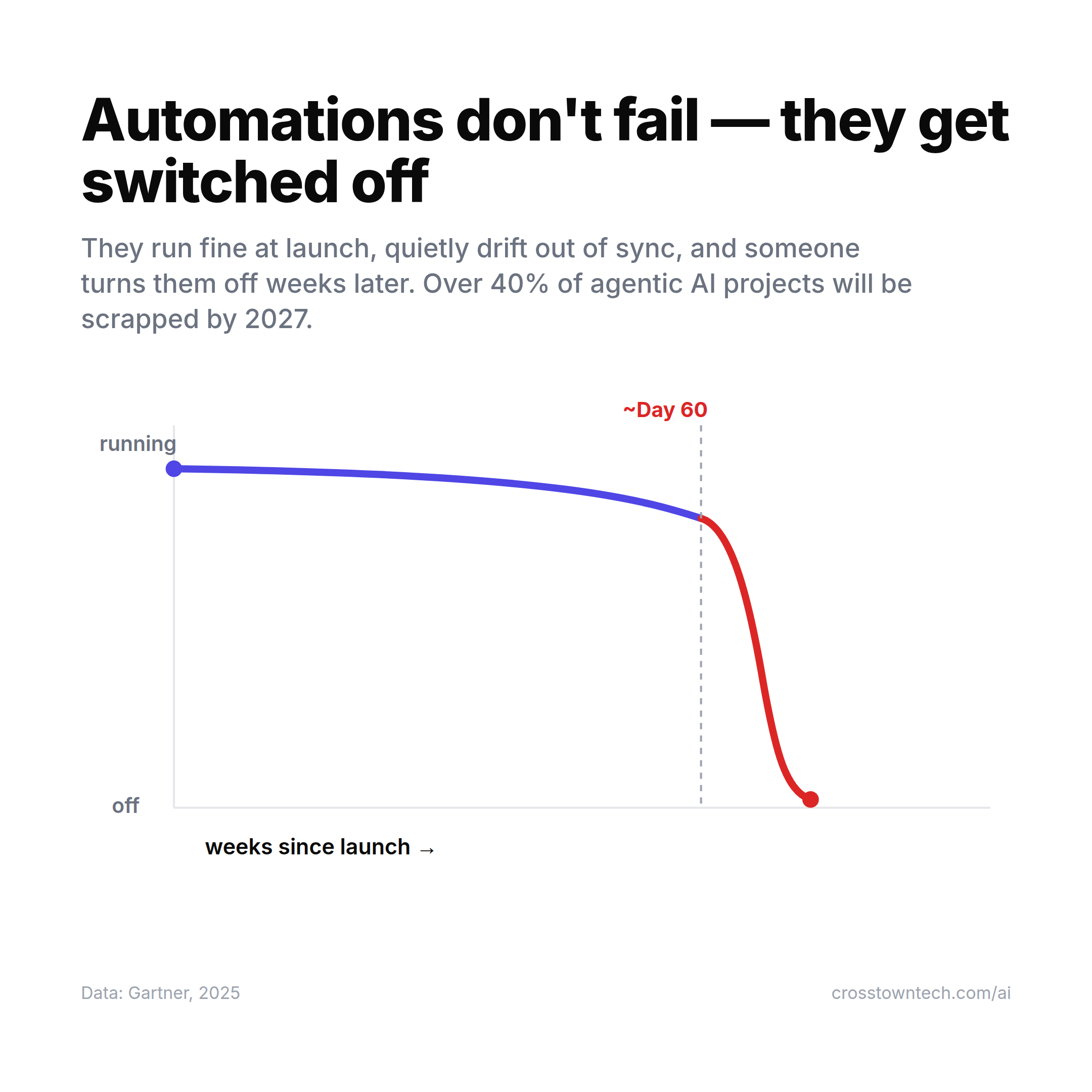
It’s the gap between “it works” and “it’s still working.” An automation launches, does the job, everyone moves on. Then the inputs change. A form gets a new field, an upstream export changes format, a policy shifts, an edge case shows up that nobody tested. None of these throw a dramatic error. They just make the automation slightly wrong, then a bit more wrong, until “small changes accumulate until the process no longer matches reality” (SEM Nexus, 2026). The stuff that kills automations tends to surface weeks-to-months in, not on day one.
This is a different death than the green-checkmark lie, where an automation runs green while handing you wrong output today. The 60-day cliff is slower and quieter: the automation isn’t lying to you, it’s just rotting, and one day someone decides it’s easier to do the task by hand again. Same outcome — a dead automation — but you get there by neglect, not by a bad run.
Why is fire-and-forget the real killer?
Because the build is the cheap part and everyone budgets like it’s the whole cost. It isn’t. Forrester pegs maintenance at up to ~60% of an automation project’s total cost (via Blueprint, 2025), and industry estimates put 30–40% of an automation team’s time into maintaining what already exists rather than building anything new (AIMultiple, 2025). That’s the RPA world’s hard-won lesson, and AI automations inherit all of it plus a model that can drift on its own.
So “fire and forget” isn’t a style choice — it’s a decision to not pay the bigger half of the bill. You launch, you don’t staff the upkeep, and the automation coasts on its launch-day config until reality moves far enough that it’s useless. Nobody made a call to kill it. It just aged out because no one was assigned to keep it current. If you never wrote down what it’s actually worth, it’s even easier to quietly drop.
How do you keep an automation alive?
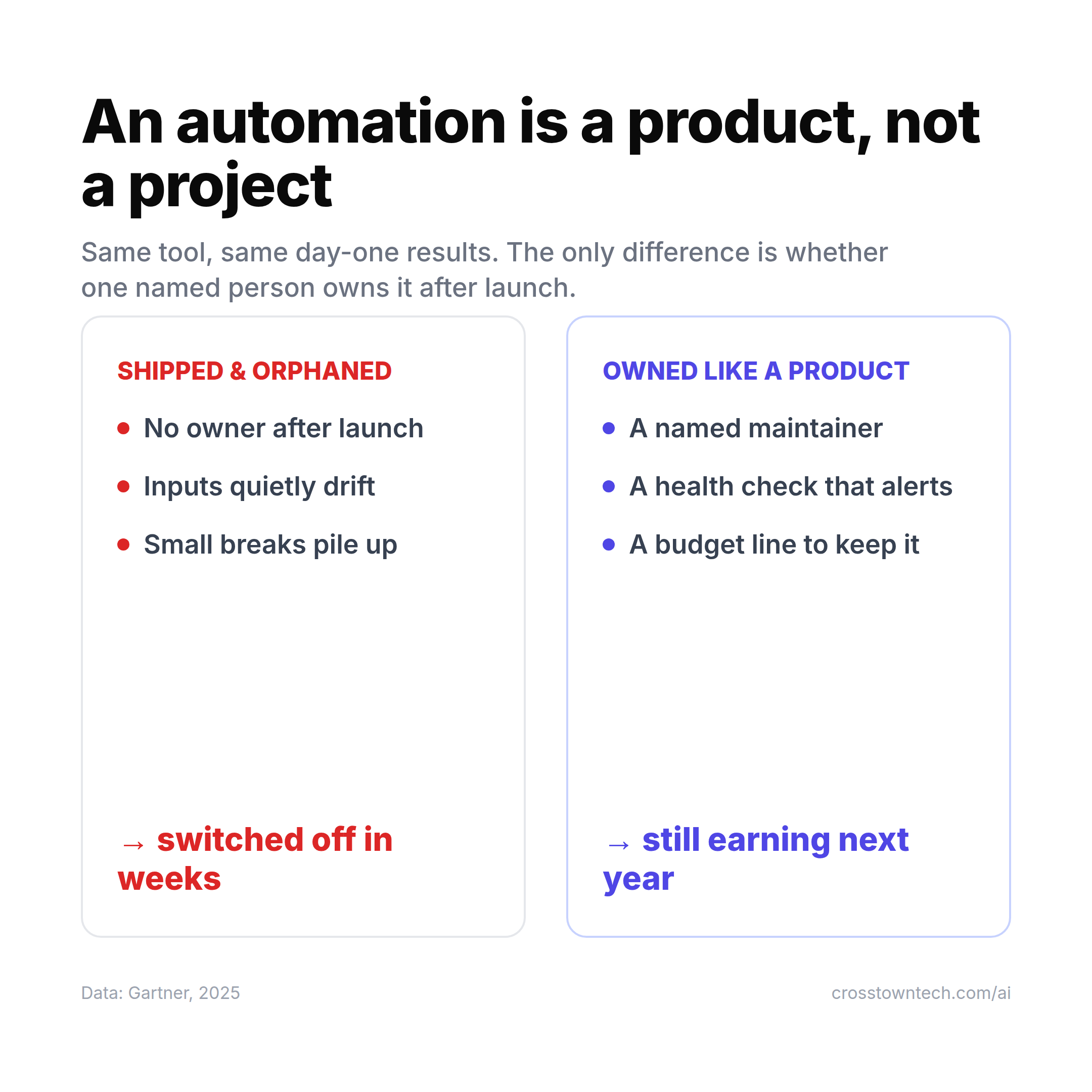
Treat it like a product with a maintainer, not a project you finished. The tool is identical on day one either way — the only thing that separates the automation that’s dead in six weeks from the one still earning next year is whether one person owns it after launch.
Four things keep an automation off the cliff:
- A named maintainer. One person, by name, accountable for this automation working. The most underrated failure mode is ownership diffusion — during the pilot it’s everyone’s job, and “once it needs to be operationalised and maintained, it’s nobody’s” (REMVER Consulting, 2026). Assign it or expect it to rot.
- A health check that alerts. Something that watches the output, not just whether the run finished, and pings a human when it looks wrong. Silent drift only kills you when nobody’s watching.
- A maintenance line in the budget. Plan for the 30–60% of ongoing cost up front so upkeep is funded work, not a favor someone does between real projects.
- A scheduled review. Every quarter, look at each automation: still needed, still correct, still worth it? This is where you catch the ones drifting toward the cliff — before they go over it.
None of this is exotic. It’s the same discipline you’d apply to any internal tool people depend on. The reason it gets skipped is that the automation worked fine in week one, so the upkeep felt optional. It wasn’t.
Should you kill automations on purpose?
Yes. A deliberate retirement beats silent rot every time. If a scheduled review says an automation isn’t worth maintaining, turn it off on purpose, tell the people who relied on it, and reclaim the attention. That’s a healthy outcome — you freed up maintenance capacity for something that matters. The failure isn’t retiring an automation; it’s letting it die unnoticed while everyone assumes it still works. Retiring one you chose to retire is portfolio management. Discovering a dead one three months later is the 60-day cliff catching you.
Whoever builds the automation is often the right person to keep owning it — the people closest to the work usually know first when it’s drifting. Just make the ownership explicit and written down, not assumed.
FAQ
Why do AI automations get abandoned after launch? Because most are shipped as one-time projects and left without an owner. When inputs drift and small breaks pile up, no one is accountable for fixing them, so the automation gets quietly switched off. Gartner expects over 40% of agentic AI projects to be canceled by 2027 — for cost, unclear value, and weak governance, not model quality.
What is the 60-day cliff? The pattern where an automation runs fine at launch, drifts out of sync over the following weeks, and gets turned off about two months in — not because it broke loudly, but because it slowly stopped matching reality and no one was maintaining it.
How much does it cost to maintain an automation? A lot more than the build. Forrester puts maintenance at up to ~60% of an RPA project’s total cost, and industry estimates put 30–40% of an automation team’s time into maintenance rather than new work. Budget for the upkeep before you build, not after.
How do you stop an automation from being abandoned? Treat it as a product, not a project: assign one named maintainer, add a health check that alerts when output looks wrong, put a maintenance line in the budget, and review each automation on a schedule to renew or retire it deliberately.
Pick one automation you launched more than a month ago and check it this week: is it still doing exactly what you think it’s doing? Then give it an owner and a place in the budget. Building the automation was the easy 80%. Keeping it alive and honest for two years is the hard 20% — and it’s the part that decides whether you’re in the 40% Gartner watches get scrapped, or the half that’s still earning.
I write one of these a week on making AI actually work inside companies — measured in what still runs a year later, not what demoed well.