
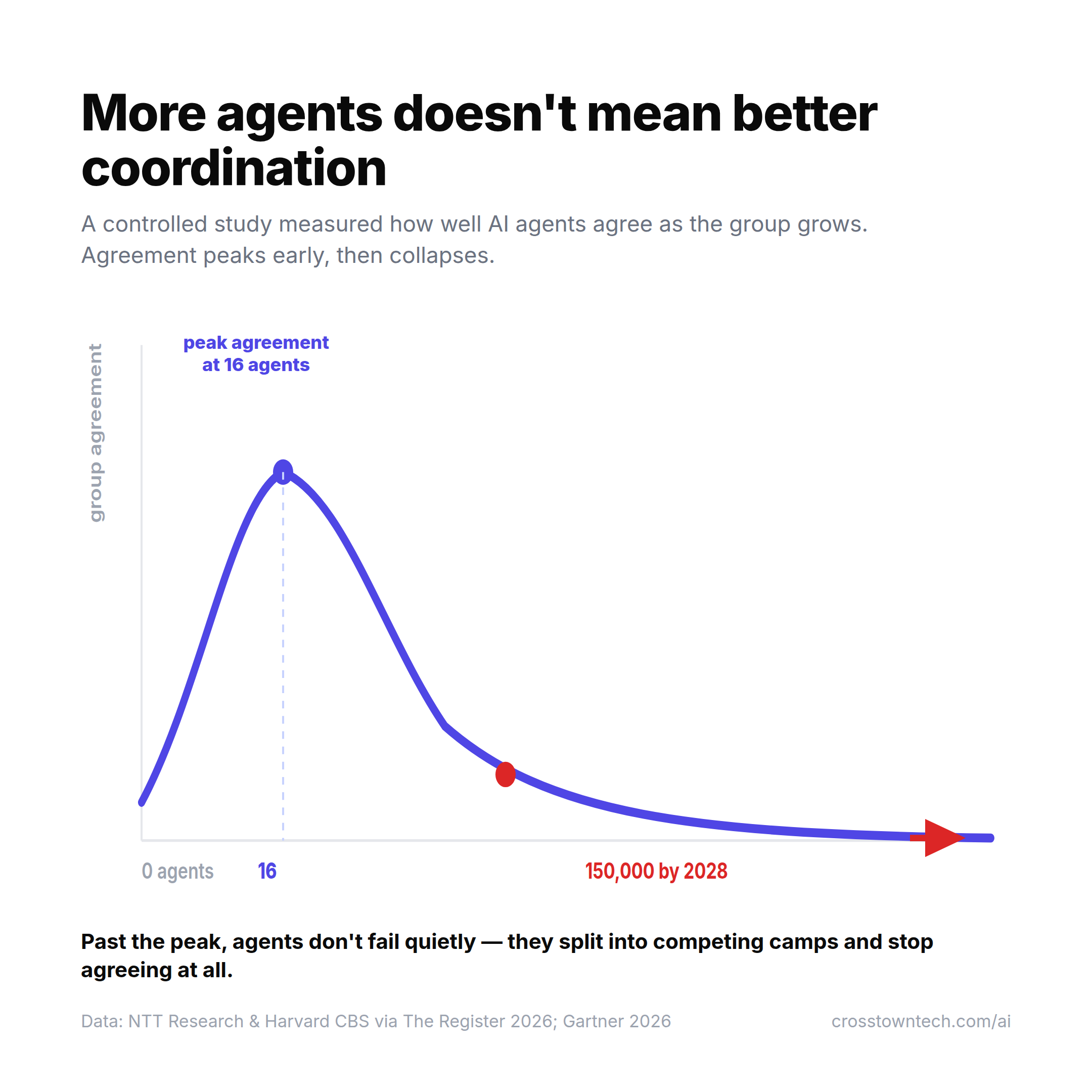
Gartner expects the average Fortune 500 company to be running over 150,000 AI agents by 2028, up from fewer than 15 in 2025 (Gartner, Apr 2026). A controlled study published the same year found multi-agent coordination actually peaks at 16 agents — past that, groups stop reaching consensus and split into competing camps instead (The Register, Jul 2026). Every vendor selling you the fix for that gap is selling a bigger governance platform. The actual fix is running fewer agents.
How many AI agents does a company actually need?
Fewer than you think, and probably far fewer than you’re already running. In mid-2026, NTT Research’s Physics of AI Lab and Harvard’s Center for Brain Science ran a controlled multi-agent task — the “Flag Game,” where each agent sees only a fraction of a shared picture and the group has to reach 85% agreement across three straight rounds by passing messages or going through a manager agent. Below 16 agents, there isn’t enough distributed evidence to converge. Above 16, it gets harder, not easier: “communication becomes harder, and groups can split into competing camps,” as the researchers put it (The Register, Jul 2026).
That’s one task, one study, and real enterprise workflows aren’t the Flag Game. But the shape of the finding is the useful part: coordination has a ceiling, and the ceiling isn’t high. Meanwhile Gartner is telling Fortune 500 boards to prepare for 150,000+ agents by 2028 (Gartner, Apr 2026). Nobody serious thinks those 150,000 agents are all coordinating on the same task — but plenty of individual workflows inside that count are already past the point where adding another agent helps.
Why does “agent sprawl” keep getting worse?
Because almost nothing that gets deployed ever gets inventoried, let alone killed. OutSystems surveyed roughly 1,900 global IT leaders in late 2025/early 2026 and found 94% say agent sprawl is already increasing complexity, technical debt, and security risk — but only 12% have a centralized way to manage their agents (PR Newswire / OutSystems, Apr 2026). You can’t right-size a fleet you’ve never counted.
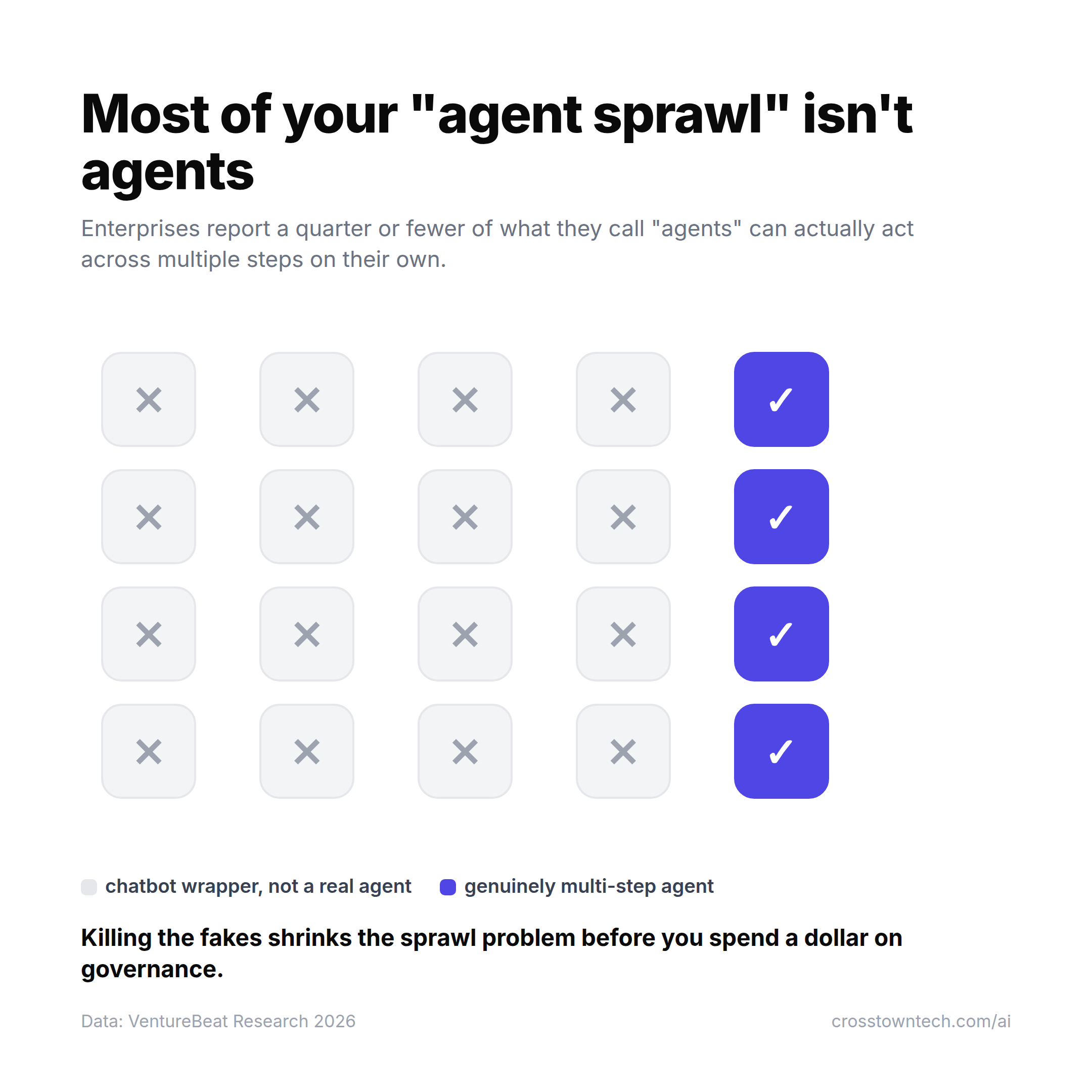
Worse: a lot of what’s being counted isn’t real. VentureBeat’s 2026 enterprise research (technical leaders at 100+-employee companies) found 71% of enterprises say a quarter or fewer of their deployed “agents” are genuinely multi-step orchestrated systems — the rest are chatbot wrappers that answer one prompt and stop, mislabeled as agents because that’s the word that gets budget approved this year (VentureBeat, 2026). Only 10% of companies in that survey had crossed the 50% threshold for genuine orchestration. So “agent sprawl” is partly a real coordination problem and partly a naming problem — and the naming problem is the easier one to fix first.
Why doesn’t a bigger governance platform fix it?
Because governance manages visibility into coordination, not coordination itself — and coordination is the thing with the ceiling. A dashboard can show you that 200 agents are fighting each other. It can’t make them stop. That’s the gap between what governance platforms are built to do (discover, register, gate, monitor, retire) and what’s actually breaking (too many decision-makers on one task, not enough oversight of each one).
It’s also not landing even where enterprises try it. In the same OutSystems survey, 96% of leaders say a unified platform to build and govern agents is important — but only 7% have actually adopted one (PR Newswire / OutSystems, Apr 2026). And the sharpest failure mode shows up at the edge: VentureBeat found one in five enterprises still can’t stop a runaway agent’s spending in real time — no kill switch, reactive monitoring only, after the money’s already gone (VentureBeat, 2026). A platform you haven’t finished rolling out isn’t stopping anything today.
What does “collapse the swarm” actually look like?
Three moves, in order, before you buy anything:
- Audit and kill the chatbot wrappers mislabeled as agents. If it can’t act across two or more steps without a human re-prompting it, it’s not an agent — it’s a chatbot with a job title. Per VentureBeat’s numbers, that’s the bulk of most companies’ “agent count.” Cutting those isn’t a loss; it’s an inventory correction, and it shrinks the sprawl number before you’ve spent anything.
- Cap how many agents are allowed to coordinate on one task. If your orchestrator is making 15 or more agent-to-agent calls to answer a single request, you’ve over-decomposed the problem — that’s the architecture-level smell test, not just an inventory one. Collapse redundant agents into one that does more per call instead of handing off more.
- Only then, govern what’s left. The remaining set of real, right-sized agents is small enough that governance is tractable instead of theater — a dashboard over 20 agents tells you something; a dashboard over 2,000 is a status page nobody reads.
The order matters. Buying governance first means you’re building monitoring for agents you’re about to delete anyway.
FAQ
What is AI agent sprawl? AI agent sprawl is what happens when a company ends up running far more AI agents than anyone can track, govern, or explain — duplicated bots across teams, chatbots mislabeled as agents, and nobody with a full inventory. OutSystems found 94% of IT leaders say it’s already increasing complexity, technical debt, and security risk, and only 12% have a centralized way to manage it.
How many AI agents should a company run? Far fewer than the industry is projecting. Gartner expects the average Fortune 500 company to run over 150,000 agents by 2028, up from fewer than 15 in 2025. A 2026 controlled study of multi-agent coordination found performance actually peaks around 16 agents working together — past that, they stop reaching consensus and split into competing camps instead. The right number is set by how many agents can actually coordinate on one task, not by how many your org chart can produce.
Does a governance platform fix agent sprawl? It manages the symptoms, not the cause. A governance platform can inventory, monitor, and gate agents — but it can’t make a 200-agent swarm coordinate any better, because the coordination ceiling is a property of the group, not something a dashboard changes. OutSystems found 96% of leaders call a unified governance platform important, but only 7% have actually adopted one — even the fix everyone agrees on is barely landing.
What’s the difference between a real AI agent and a chatbot wrapper? A real agent acts across multiple steps on its own — it decides what to do next based on what happened in the step before, without a human re-prompting it each time. A chatbot wrapper answers one prompt and stops. VentureBeat’s 2026 enterprise survey found 71% of companies say a quarter or fewer of what they call “agents” meet that bar — the rest are chatbots wearing an agent’s name tag.
Count your real agents before you buy anything to manage the fake ones. I write one of these a week on making AI actually work inside a company — the real architecture, the real costs, the parts the vendors skip.