
You bought Microsoft 365 Copilot at $30 a seat because it was the cheap option. A year in, weekly active use sits at 30-55% of the seats you’re paying for. Divide the bill by the people who actually log in and your $30 tool costs 2-3x that per active user — Redress Compliance, 2026. The sticker price was never the real price. It’s the smallest number in the decision, and every vendor leads with it because the honest one is worse.
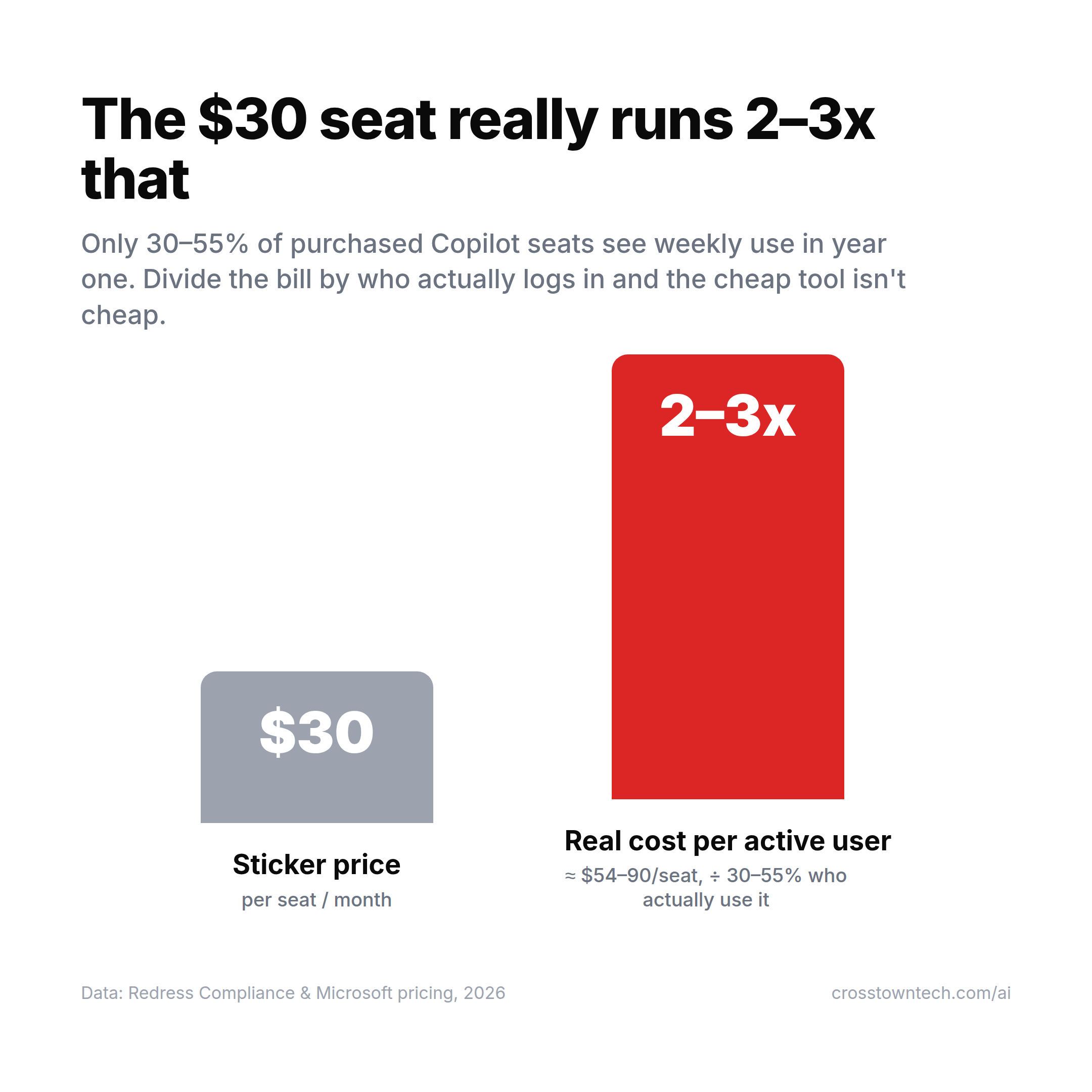
Glean, Copilot, and building it yourself look nothing alike on price. Once you divide each by who actually uses it, they converge into the same expensive band — and the real decision was never about price at all.
How much do Glean, Copilot, and building your own actually cost?
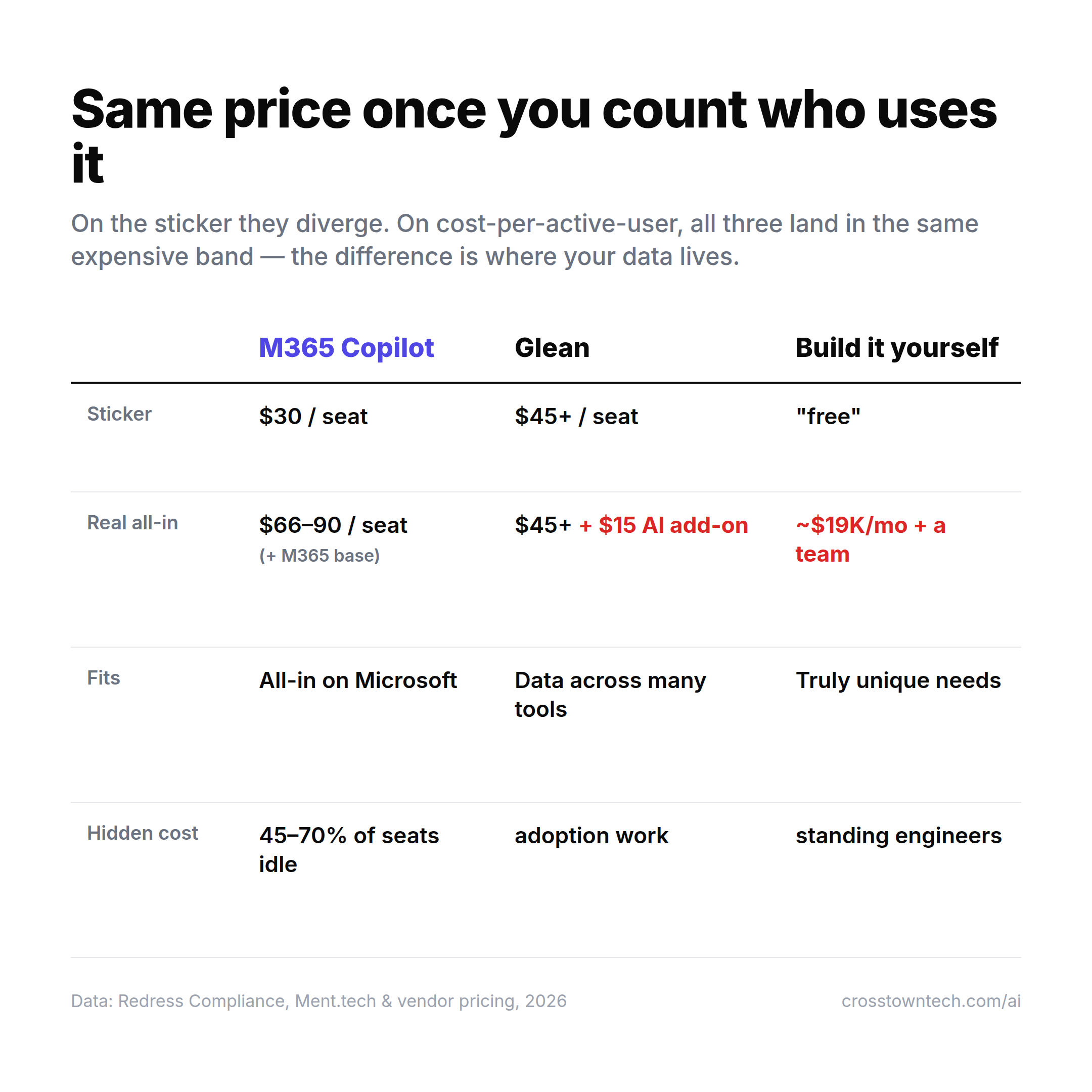
More than the sticker, in every case. Copilot is $30/user/month, but it’s an add-on — it needs a qualifying Microsoft 365 base, and after Microsoft’s July 2026 price hike that’s E3 at $39 or E5 at $60/user/month. All-in, budget $66-90/user/month (copilot-experts.com, 2026). Glean publishes no price card — every deal is a custom quote — but third-party reporting puts the floor at $45-50/user/month plus a ~$15/user/month Work AI add-on, with a 100-seat minimum and a $60-75K first-year floor before implementation work (ExploreAgentic, 2026). Build it yourself looks free until you price the infrastructure: a production RAG system at 100K queries/day runs ~$19,460/month — $12K in embeddings, $4.5K reranking, $1.5K LLM calls, ~$960 vector DB, $500 infra — before you staff the team to run it (Ment.tech, 2026).
On paper these three diverge wildly. In practice, once you divide by who actually uses the thing, they land in roughly the same place.
Why is the sticker price the wrong number?
Because you pay per seat and get value per use, and most seats don’t get used. Weekly active use of purchased Copilot licenses lands between 30% and 55% in the first year — the curve peaks at launch, fades as the novelty wears off, and settles by end of quarter one at whatever level decides your real spend. Once you count the idle seats, the effective cost per active user runs 1.8 to 3 times list price (Redress Compliance, 2026). A $30 seat used by roughly a third of the people you bought it for is closer to a $60-90 seat. Cost-per-active-user, not cost-per-seat, is the only honest number here — the same discipline as measuring AI ROI by cost per successful case instead of hours claimed saved.
This isn’t a Copilot-specific problem. It’s what “seat-based pricing” always hides: the bill scales with headcount, the value scales with habit, and vendors only ever show you the first one.
Why do these rollouts stall — and is it the tool?
No. The stall happens between the pilot and the scale-up, and it’s a management failure, not a model failure. In Gartner’s 2025 Microsoft 365 and Copilot Survey — 187 IT and customer-service leaders, most of whom had already piloted Copilot — only 5% of the organizations that finished a pilot moved to larger-scale deployment (TechPartner.News reporting on Gartner, June 2025). Meanwhile the licenses keep selling: Microsoft crossed 30 million paid Copilot seats by Q4 FY26, adding 10 million in a single quarter, and Copilot adoption reached 41% of Microsoft 365 enterprise customers by Q1 2026 (AI Business Weekly, 2026). Buying keeps accelerating. Scaling doesn’t.
The gap has a known shape. Rollouts with a named task and manager follow-up hold usage 2-3x higher than broad all-staff launches (Redress Compliance, 2026) — the same “cohort, not company-wide” pattern that works for any workflow change. The tool you pick barely moves this number. Whether anyone owns making people use it does.
So which should you actually pick?
Stop comparing sticker prices — they’re all going to land in the same band once real usage is counted. Pick by two questions instead: where does your data live, and who’s going to own adoption?
- Copilot — if you’re already all-in on Microsoft 365 and want AI inside the apps people already open. Easiest to buy, hardest to get used: without a named task and a manager checking in, most of the seats you paid for sit idle.
- Glean — if your knowledge is scattered across many tools and you’re willing to fund the adoption work a horizontal search layer needs. You’re paying for reach and for someone else’s retrieval quality; check it actually covers your top systems before you sign.
- Build it yourself — only if you have genuinely unique requirements and an engineering team that would exist anyway. For almost everyone else, this is the most expensive way to end up in the same place — you’re trading a vendor’s platform fee for your own standing headcount, and you still have to solve adoption.
This is the buy-versus-build half of a decision I’ve written about before — The Context Stack covers the architecture question (plug into your tools, buy a layer, or build the pipework), and this is the same three choices priced honestly. The tool was rarely the bottleneck either way — see why swapping models doesn’t move the needle the way your context and adoption plan do.
FAQ
Is Microsoft 365 Copilot actually cheaper than Glean? Not once you count usage. Copilot’s $30 add-on looks cheap next to Glean’s $45+/seat, but only 30-55% of purchased Copilot seats see weekly use in year one — so the real cost per active user runs 2-3x the sticker, landing in the same expensive band as Glean’s all-in price.
How much does Glean actually cost? Glean publishes no price card. Third-party reporting puts it at $45-50/user/month plus a ~$15 Work AI add-on, with a 100-seat minimum and a $60-75K first-year floor before implementation.
Is it cheaper to build your own AI search than buy Glean or Copilot? Almost never. A production RAG system at 100K queries/day runs about $19,460/month in infrastructure alone, before you staff the data scientists, security, and DevOps work to keep it running. Build only wins with genuinely unique requirements and an in-house team who’d exist anyway.
Why do so many Microsoft 365 Copilot rollouts stall? The failure point is the pilot-to-scale jump, not the tool. In Gartner’s 2025 Microsoft 365 and Copilot Survey, only 5% of organizations that finished a pilot moved to larger-scale deployment — the rest stayed stuck without a named task or manager follow-up to sustain use.
Before you sign anything, do the division yourself: take each option’s real yearly cost and divide by the number of people who’ll actually use it every week, not the number of licenses on the invoice. Name who owns getting them there. That number is your real bill — the quote is just the opening offer.
I write one of these a week on making AI actually work inside a company — the real architecture, the real costs, the parts the vendors skip.