
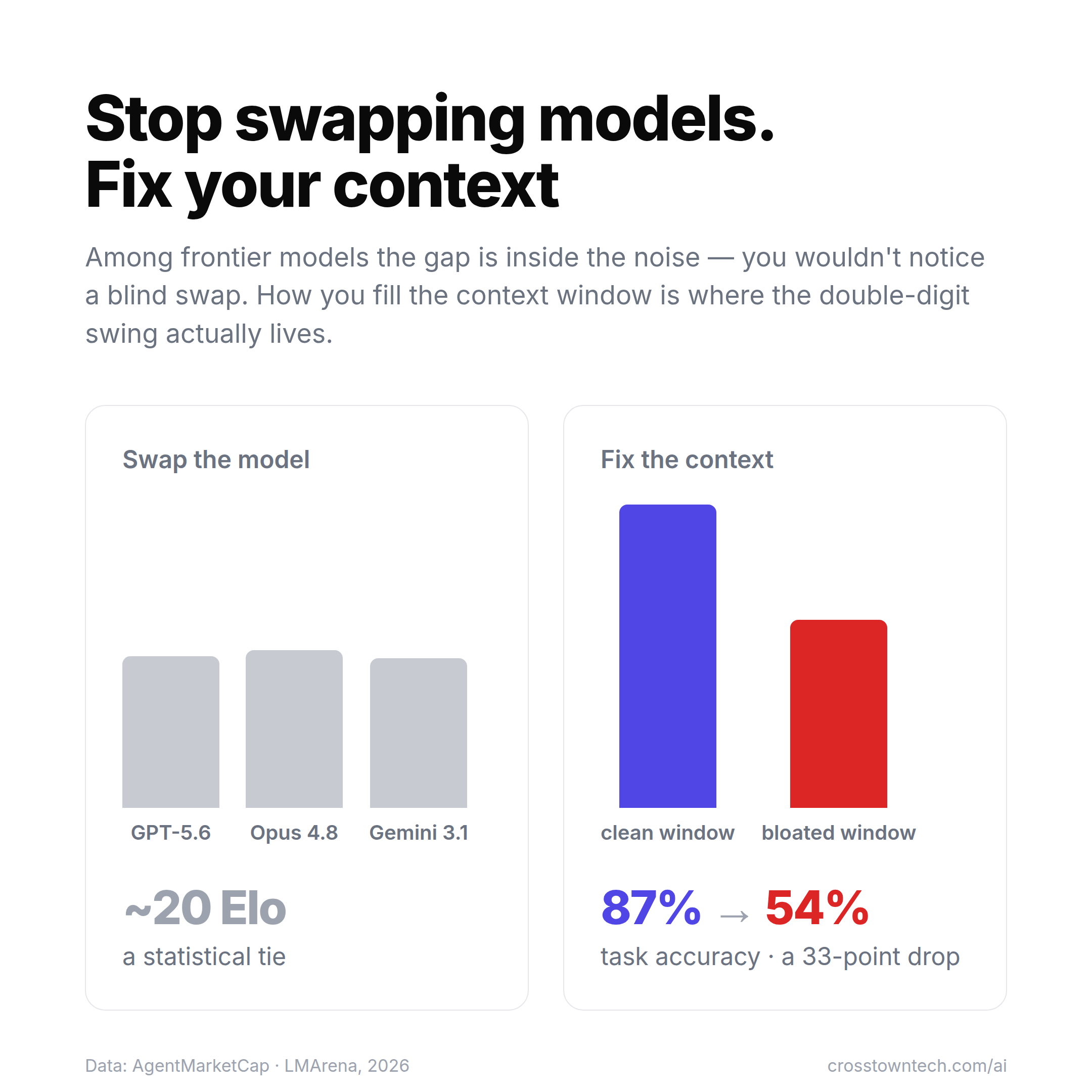
Someone on r/ClaudeAI put it perfectly: “You wouldn’t notice if we swapped the model.” They’re right. On the work you actually do, the top frontier models — Claude, GPT, Gemini — now sit within about 20 Elo points of each other on the LMArena leaderboard, a statistical tie. The thing that moves your results by double digits isn’t the model. It’s the context you feed it and the workflow around it. Stop model-shopping. Fix the pipework.
There’s a pattern that gives the whole game away. A new model drops, and within a day people swear the one they were using “got worse.” A week later they’ve adapted, the panic fades, and they forget they ever panicked — right up until the next release, when it happens again. That loop isn’t a flaw in you. It’s the tell that the model was never the variable you were actually reacting to.
Would you actually notice if we swapped your model?
Probably not. The frontier models you’d choose between — GPT-5.x, Claude Opus 4.6/4.8, Gemini 3.1 Pro, Grok 4 — cluster in a narrow Arena-Elo band, and gaps under ~20 Elo are noise. The standard advice now is to treat #1 through #3 as a tie and run your own 50-prompt eval before committing, because the leaderboard can’t separate them for you (aizolo, 2026).
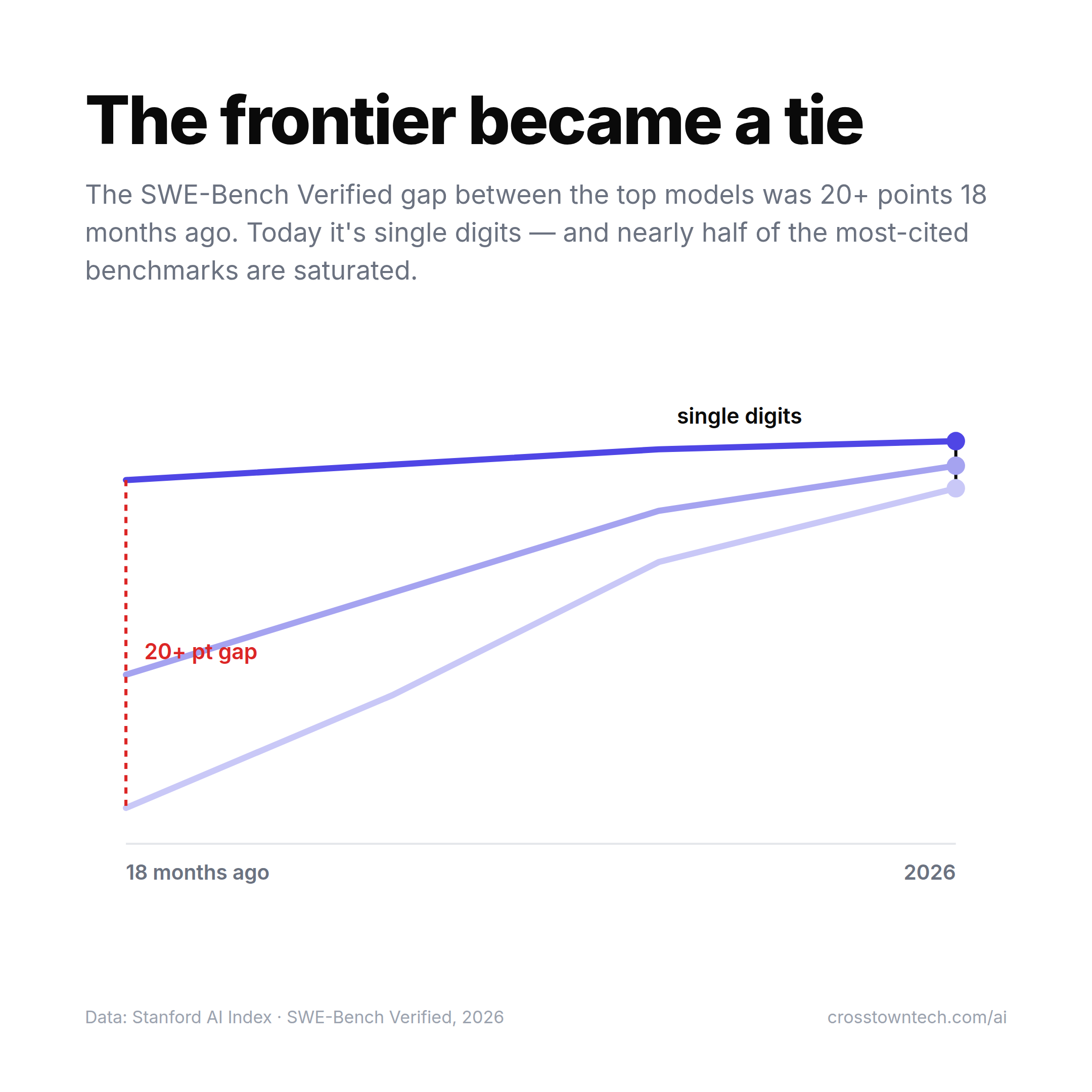
The benchmarks agree. Stanford’s 2026 AI Index found nearly half of the 60 most-cited LLM benchmarks are now saturated, and the SWE-Bench Verified gap that was 20+ points 18 months ago has shrunk to single digits (Milind Nair, LLM Evaluation in 2026). Once the top ten score within two points of each other, the benchmark tells you who’s in the club — not who’s best.
Is the tie itself real, or just a contaminated benchmark?
Partly the latter — and that’s worth knowing before you lean on any leaderboard. Saturated benchmarks like SWE-bench Verified don’t cluster models tightly only because the models are equal; some of that closeness is measurement error. OpenAI’s own 2026 audit found diagnostic subtasks where models scored up to 76% through memorization alone, with direct solution leakage present in 30%+ of “successful” passes, and agent-scaffold choice alone can inflate a raw score by more than 12 points (AgentMarketCap, Approaching 90%, 2026). Move the same models to a harder, less-gamed eval and the gap reappears fast: the model class scoring near 80% on SWE-bench Verified in early 2026 drops into the high-50s on SWE-bench Pro — a 25-to-35-point swing from benchmark difficulty alone, not from swapping models.
That’s a case for the advice in this piece, not against it. If a chunk of the public tie is a measurement artifact, the fix isn’t hunting for a “less contaminated” leaderboard — it’s running your own eval on your own task, which is exactly the move in step 4 below.
Then why does it always feel like the model changed?
Because your context changed, not the weights. Two things drive the “it got dumber” feeling. First, anchoring: you had a good session, you expect it every time, and any regression to the mean reads as decline. Second — and this is the real one — context rot. Chroma tested 18 frontier models (GPT-4.1, Claude 4, Gemini 2.5, Qwen3) and every single one degrades as the input grows. A model with a 200K-token window starts slipping around 50K tokens, well before it’s anywhere near full (Chroma Research, Context Rot, 2025).
So the same model gets measurably worse as your thread gets longer. That’s not a new release nerfing you. That’s the window you’ve been filling.
If the model isn’t the bottleneck, what is?
Your context and your workflow. Here’s the number that should end the argument. In one 2026 analysis, wiring three MCP servers (about 40 tools) into an agent consumed 143K of a 200K-token window — 72% — before the user asked a single question. Task accuracy fell from 87% to 54%, and tool-selection accuracy collapsed from 43% to under 14% (AgentMarketCap, 2026).
That’s a 33-point swing in accuracy — from context alone, same model. No model upgrade on the market buys you a 33-point jump on your real tasks. Your context pipeline can lose you one by accident. The model is a rounding error; the context is a cliff. (If you want the map for wiring context in properly, that’s the companion piece: The Context Stack.)
What model-shopping actually costs you
More than the API bill. Swapping LLMs isn’t plug-and-play — teams rewrite and re-test prompts for weeks, re-run regression suites, and restage rollouts every time they chase a new release. One analysis modeled a $60K/month LLM budget and found a $333K/year gap between constant manual switching and just committing to one model with smart routing (VentureBeat, 2026).
And that’s only the visible cost. The real one is the features that never ship because your team is perpetually retooling instead of building. The frontier ships on a roughly weekly cadence now — if “which model” is the thing you re-litigate every release, you’ve anchored your business to the one variable guaranteed to keep moving.
But aren’t some models just better?
Yes — across tiers, not within them. This isn’t “all models are equal.” Frontier models still beat open-source by a clear margin: one 2026 analysis put the gap around 21 points, with open-weight models clustering at 40–52% on SWE-Bench versus 60–64.7% for the top proprietary ones (aizolo, 2026). The tier absolutely matters. Pick a frontier model. Then stop — because inside that tier you’re already paying for, the choice is noise.
What to fix instead
Here’s where the double-digit gains actually live:
- Lock one frontier model. Pick from the top tier and commit. Re-evaluate on a quarter, not on every release.
- Wire in your context. What the model knows about your company, docs, and data is the lever — see The Context Stack.
- Prune the window. Fight context rot and tool bloat. Fewer, sharper tools and shorter working context beat a bigger window you’ve stuffed full.
- Eval on your task, not the leaderboard. A 50-prompt test on your actual work tells you infinitely more than an Arena rank — and score it on cost per successful case, not hours saved.
- Write the workflow down. If your setup is documented, swapping models later is a non-event instead of a fire drill — an Agent Workspace is where that documentation lives.
FAQ
Is one AI model clearly better than the others in 2026? Across tiers, yes — frontier beats open-source by roughly 21 points. Within the frontier tier (Claude, GPT, Gemini), no: the top models sit within ~20 Elo, a statistical tie on real work.
Why does my AI model feel like it got worse after an update? Usually it’s context rot or anchoring, not the weights. Every frontier model degrades as the thread grows — a 200K-window model starts slipping around 50K tokens — so a long or bloated context makes the same model perform worse.
Should I switch models when a new one launches? Rarely. Constant switching modeled out to a $333K/year cost on a $60K/month budget, mostly in re-tuning and re-testing. Commit to one frontier model and re-evaluate on a quarterly cadence instead.
What actually improves my AI results the most? Your context and workflow. Cleaning up what you feed the model moved task accuracy 87% → 54% in one test — a bigger swing than any model upgrade delivers.
Stop opening the leaderboard. Open your context pipeline instead — that’s where the real gains are, and it’s the part worth the effort. If you want the how-to for wiring your company’s context into whatever model you land on, read The Context Stack.
I write one of these a week on making AI actually work inside companies — measured in outcomes, not hype.