
You’re probably measuring AI ROI in “hours saved.” Drop it — that number is mostly fiction. To get a figure you can defend, do what you’d do for any investment: pick one workflow, write down its real cost before AI, and track the net change that actually shows up in the books — as cost per successful case, not adoption and not raw hours.
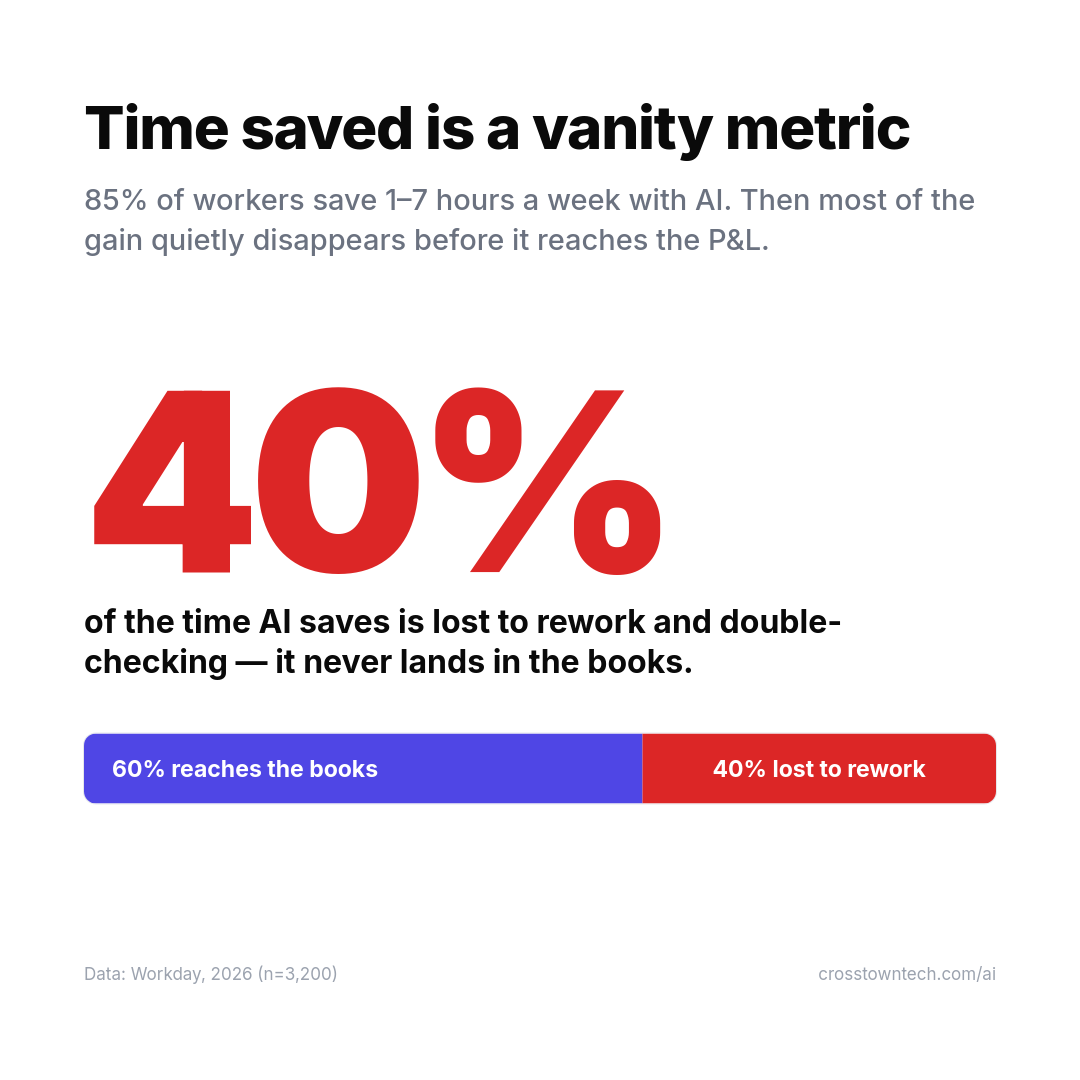
Here’s the study that shows why the usual number lies. Workday surveyed 3,200 business leaders in 2026: 85% say AI saves them 1–7 hours a week — but about 40% of that saved time is immediately lost to rework and double-checking (Workday, 2026). The headline hours are real. The value evaporates before it reaches the P&L.
Why is AI ROI so hard to measure?
Because the default metric — self-reported time saved — never reaches the books. Someone shaves 40 minutes drafting a doc, then spends 25 checking and fixing it, and the “saved” 40 gets reported anyway. Across a company that gap is huge: about 40% of the time AI saves is spent on rework (Workday, 2026). No surprise, then, that 56% of CEOs report zero cost or revenue improvement from AI in the past year, with only 30% seeing a revenue lift (PwC, Jan 2026).
It’s not that AI does nothing. It’s that “hours saved” is the wrong ruler. 44% of executives say generative AI is the single hardest type of AI to measure ROI for (Grant Thornton, 2026) — largely because everyone’s measuring a number that was never going to land on a financial statement.
What should you measure instead of “time saved”?
The net change on one workflow — cost per successful case, cycle time, and error rate — not adoption and not raw hours. “Cost per successful case” is the one that matters: what does it now cost to get a finished, correct output, start to finish, including the human cleanup?
That last part is the whole game. A step that saves 10 minutes but adds 12 minutes of checking isn’t automation — it’s work displacement dressed up as a win (AI Operator, 2026). Cost per request hides that; cost per successful case exposes it. Three numbers, one workflow:
- Cost per successful case — total cost (tool + human time) ÷ finished, correct outputs.
- Cycle time — how long the whole workflow takes now vs. before.
- Error/rework rate — what share of AI output needs a human fix before it ships.
How do you baseline a workflow before rolling out AI?
Write down the week-0 numbers before anyone touches AI: time, cost, error rate, and volume for that one workflow. No baseline, no ROI claim — you can’t prove a delta you never measured against.
This is the step nearly everyone skips, and it’s why the arguments about AI ROI never end: with no “before,” any “after” is just a vibe. Pick your most expensive repetitive workflow — invoice coding, first-line support replies, contract review, whatever costs real money and repeats. If you can’t name it from the org chart, ask the people doing the work; they already know which job to automate. Measure it for a week as it runs today. That boring spreadsheet is the entire basis for every ROI number you’ll cite later.
How do you tell which AI tools actually save time?
Adoption isn’t the answer — a tool with 90% adoption and no movement in the workflow number is a cost, not a return. The only honest test is whether cost per successful case went down after you turned it on. If it didn’t move, the tool isn’t saving time; it’s just being used.
This matters because “usage” dashboards are the easiest thing to show a board and the least connected to money. 74% of organizations want AI to grow revenue, but only 20% have actually seen it (Deloitte, 2026) — a lot of that gap is teams counting seats and logins instead of outcomes. Measure the workflow number per tool, and kill the tools that don’t move it.
There’s a macro version of the same trap. When the Bank of Korea studied AI at work in 2026, it found AI cut work time by about 3.9% (~1.5 hours a week) — but the time saved did not translate into higher output (Bank of Korea, June 2026). Freed-up minutes only count if they turn into more finished work or lower cost. If you can’t see that in the workflow, you haven’t found ROI — you’ve found a time saving that leaked away.
What’s a realistic AI ROI and timeline?
On one targeted workflow you should see a clear trend by week 6–8 — either cost per successful case is trending down or the tool isn’t earning its place. Vendor case studies love to quote ~3:1 returns in year one; treat those as ceilings under ideal conditions, not defaults you’ll hit.
The honest framing: most of the value shows up when you fix one workflow properly, not when you sprinkle AI across everything. Score the workflow, be honest about whether it actually shipped cheaper and faster, and let that one real number set your expectations for the next one. That’s the same discipline that separates the companies seeing returns from the 56% who aren’t — they measure a workflow, not a mood.
FAQ
What is a good way to measure AI ROI? Pick one workflow, baseline its cost, cycle time, and error rate before AI, then track cost per successful case after. ROI is the net change on that workflow that shows up in the books — not self-reported time saved.
Why is “time saved” a bad AI metric? Because roughly 40% of the time AI saves is immediately lost to rework and checking, so it never reaches the P&L (Workday, 2026). Reported hours saved overstate the real gain.
What does “cost per successful case” mean? The total cost (AI tool + human time) to produce one finished, correct output — including any cleanup. It’s the number that catches work that got displaced rather than removed.
How long before I see AI ROI on a workflow? On a single, well-chosen workflow, expect a clear trend within 6–8 weeks. If cost per successful case hasn’t moved by then, the tool is a cost, not a return.
Pick your most expensive repetitive workflow, write down its week-0 numbers this week, and measure the delta in six weeks. That one honest before-and-after will tell you more than any adoption dashboard — and it’s the number you can actually defend.
I write one of these a week on making AI actually work inside companies — measured in outcomes, not hype.