
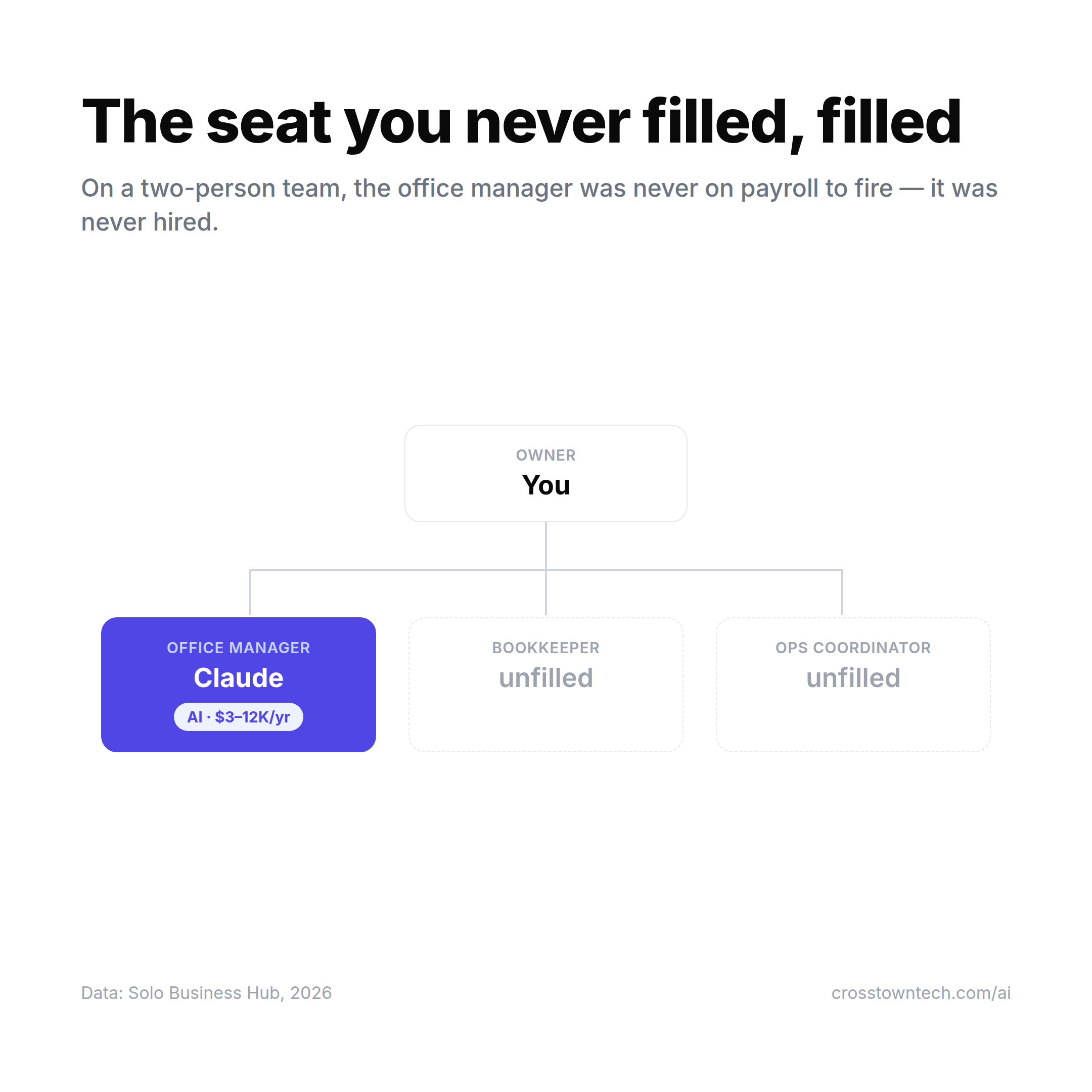
A two-person landscaping business posted a thread on r/ClaudeAI that stuck with me. No receptionist, no bookkeeper, no ops person — just two guys and a truck. Somewhere along the way they realized Claude had quietly become their office manager. It writes the quotes, chases the invoices, drafts the customer emails, keeps the schedule from falling apart. Not because they fired anyone. Because they finally had one.
That’s the story almost nobody is telling about AI and small business. Everyone’s arguing about the layoff. For a team of two, there was never a layoff on the table — there was a hire they could never justify.
Is AI actually taking small-business jobs?
Mostly, no. 58% of small businesses say cutting staff for AI efficiency is “not at all possible,” and only 12% call it even “very likely” in the next 12 months (Business.com, 2026 Small Business AI Outlook). The layoff narrative is built on enterprise headlines — a bank shedding 5% of its ops team — and then stapled onto every business with an EIN.
But a five-person shop doesn’t have a back office to cut. There’s no layer of admin to automate away, because they were never able to afford that layer in the first place. The owner is the back office, at 11pm, after the real work is done. AI doesn’t threaten that job. It’s the first thing in years that actually helps with it.
What role does AI actually fill in a small business?
The one you never hired. Admin, ops, first-draft-everything — the work that piles up because it’s nobody’s actual job.
The numbers back the anecdote. 91% of solopreneurs say AI cut their admin work — marketing, analysis, support (Solo Business Hub, Solopreneur Statistics 2026). 74% have already adopted it, closer to a first hire than a tool. And it’s not fringe: 47% of SMBs already run AI in HR and admin — screening, onboarding, engagement (Business.com). The back-office desk is exactly where adoption concentrates, because that’s the seat that was always empty.
Notice what’s not on that list: nobody’s replacing the landscaper. The skilled, on-site, judgment-heavy work stays human. What gets offloaded is the invisible coordination tax that used to eat the owner’s evenings.
Why “the hire you couldn’t afford” beats “the job it replaces”
Run the math the way an owner actually does. A competent office manager or ops admin runs $45–55K a year, fully loaded — a real number you cannot justify on a two-person P&L. So you don’t hire. You do it yourself, badly, late.
The AI version of that seat costs $3,000–$12,000 a year and, per the solopreneurs living it, roughly triples output on the admin side (Solo Business Hub). That’s a fraction of one salary. The average small-business worker saves 5.6 hours a week; managers save 7.2 (Business.com).
This is the part the layoff framing gets exactly backwards. It’s not cheaper labor replacing expensive labor. It’s labor that never existed on your books — a seat you’d priced out of, suddenly filled. 57% of U.S. small businesses invested in AI in 2025, up from 36% in 2023, and the fastest-adopting segment is the smallest firms — the ones with no back office to begin with.
How to actually make AI your office manager this week
The gap between “I use ChatGPT sometimes” and “AI runs my admin” is setup, not magic. Four steps:
- Name the seat. Write the job description for the hire you can’t afford. “Office manager: handles quotes, invoicing follow-up, scheduling, customer email, weekly reporting.” Concrete duties, not “help with stuff.”
- List the recurring jobs. The things that happen every week and always slip. Those are the tasks worth wiring, in priority order.
- Give it your context. An office manager who doesn’t know your pricing, your clients, or your tone is useless — same with AI. Feed it the real material (see The Context Stack for the three ways to wire company data into the models you already use, and Agent Workspace for the one-folder setup I run my own work through).
- Keep a human on judgment. The AI drafts and chases; you approve anything that touches money or a client relationship. That’s the whole loop.
Do that and the “AI employee” hype resolves into something boring and real: the recurring admin gets done, and your evenings come back.
The reframe
For the 30M+ micro-businesses in the US, the layoff debate is a category error. The office manager was never on payroll to fire. The honest question isn’t “will AI take this job” — it’s “which unfilled seat on your team are you finally going to fill.”
So name it. Write the job description for the hire you can’t afford, then hand it to the AI you already pay for.
FAQ
Is AI replacing office managers in small businesses? Not by firing them — most small teams never had one. 58% of SMBs say cutting staff for AI is “not at all possible” and only 12% call it likely. AI fills the admin seat the team couldn’t afford to hire, rather than displacing an existing employee.
How much does an “AI office manager” cost vs. a real hire? A fully-loaded admin or office manager runs roughly $45–55K/year. Comparable AI tooling runs $3,000–$12,000/year — a fraction of one salary — and solopreneurs report roughly tripling their admin output with it.
What admin work can AI actually handle for a small team? Quotes and proposals, invoicing follow-up, scheduling, customer email drafts, and weekly reporting are the common wins. 91% of solopreneurs say AI cut their admin workload; 47% of SMBs already use it for HR and admin tasks.
I write one of these a week on making AI actually work inside real companies — the unglamorous adoption stuff, not the hype.