
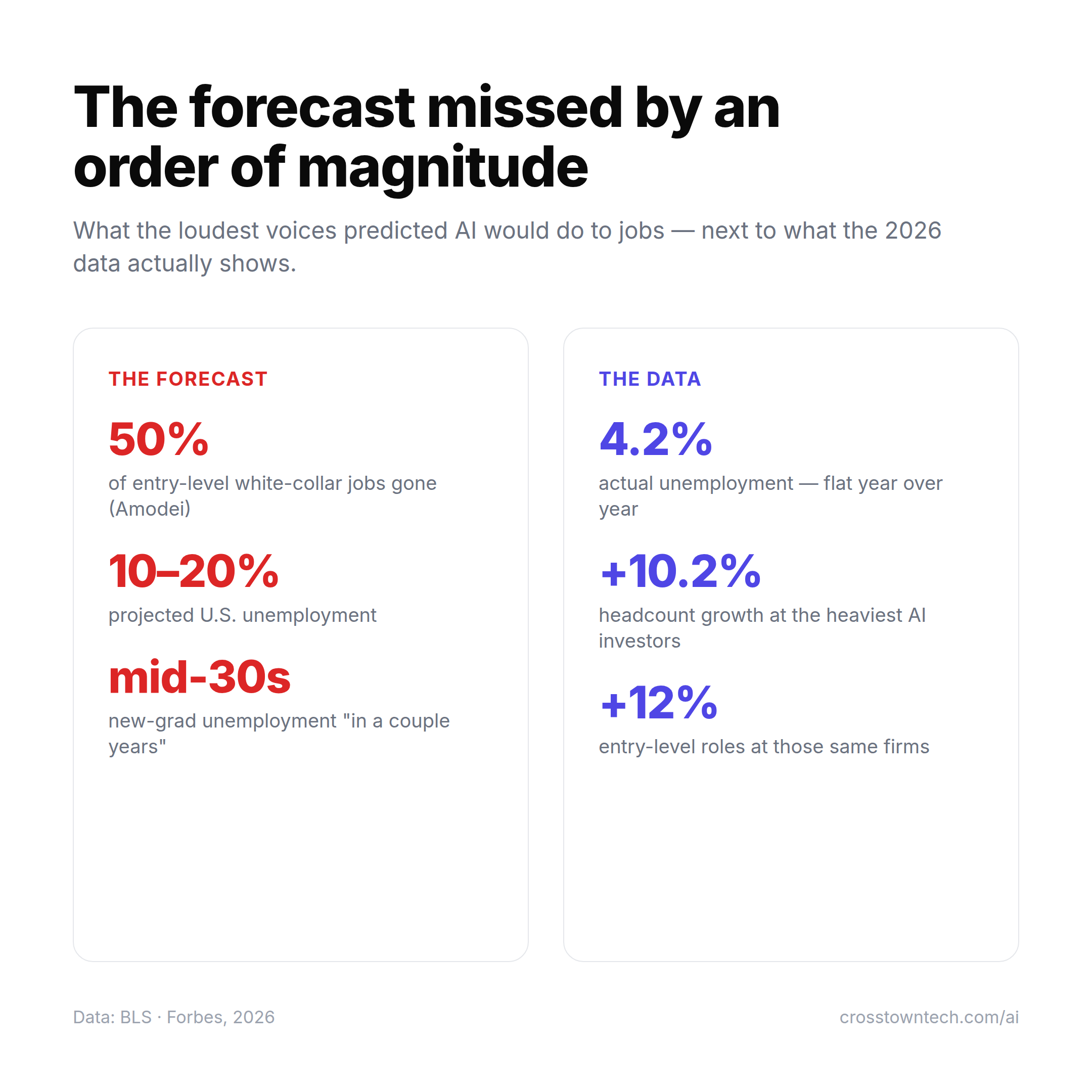
The people who told you AI would erase half of all entry-level jobs are quietly walking it back. U.S. unemployment is 4.2% — basically flat year over year. The predicted white-collar bloodbath didn’t show up in the data. So what actually happened, and what should you actually worry about? Two things, and neither one is the headline.
Is AI causing mass layoffs?
No. It’s causing a boomerang. Companies announced AI would do the work, cut staff, and then — six to twelve months later — started hiring the same people back.
The numbers are blunt. Of companies that cut jobs citing AI, roughly two-thirds are already rehiring; 35.6% have rehired more than half the roles they eliminated, most within six months (Careerminds, via CNBC). And the math didn’t math: one in three spent more on re-staffing than the AI ever saved them. Forrester now finds 55% of employers regret their AI-driven layoffs and expects half of those layoffs to be reversed “in some form” by the end of 2026. Ford is rehiring experienced engineers to fix quality problems automation couldn’t; IBM and Commonwealth Bank of Australia have publicly refocused on human staff after cutting (Forbes). The layoff was the press release. The rehire is the data.
Why do companies that fire for AI end up rehiring?
Because AI does about 60% of a job and none of the last 40%. The pattern is consistent: automate the routine bulk of a role, discover the remaining part — judgment, edge cases, the customer who doesn’t fit the script, someone to be accountable when it’s wrong — was the actual job, and hire a human back to do it.
This is the thing the “AI replaces the worker” framing gets backwards. A tool completes tasks; it doesn’t complete jobs. A role is a bundle of tasks plus the judgment to know which task the situation actually calls for. Strip out the tasks and the judgment doesn’t automate — it just becomes un-owned, until something breaks and you rehire the owner. Companies that cut before they understood which 40% was load-bearing are the ones paying the boomerang tax.
So the “AI is taking the jobs” headline was just wrong?
On scale, yes — by an order of magnitude. Unemployment sits at 4.2%, with the BLS reporting little change over the year. The companies investing most heavily in AI grew headcount 10.2% in the two years after adopting it, with entry-level roles at those firms up 12% (Forbes). Goldman Sachs pegs actual AI displacement at roughly 16,000 net U.S. jobs a month — about 0.1% of the workforce (Axis Intelligence). Real, but a rounding error next to “10–20% unemployment.”
Even the productivity story is softer than the hype. METR’s 2025 trial famously found experienced developers were 19% slower with AI while feeling 20% faster — though METR itself walked the finding back in February 2026, citing selection bias in who volunteered for the no-AI arm. Read that as a caution, not a verdict: the feeling of speed keeps running ahead of the measurement, which is exactly how you talk yourself into a layoff the data won’t back.
Then what should I actually worry about?
The first rung. This is the real, narrow harm the headlines buried: it’s not everyone’s job, it’s the entry point to a career.
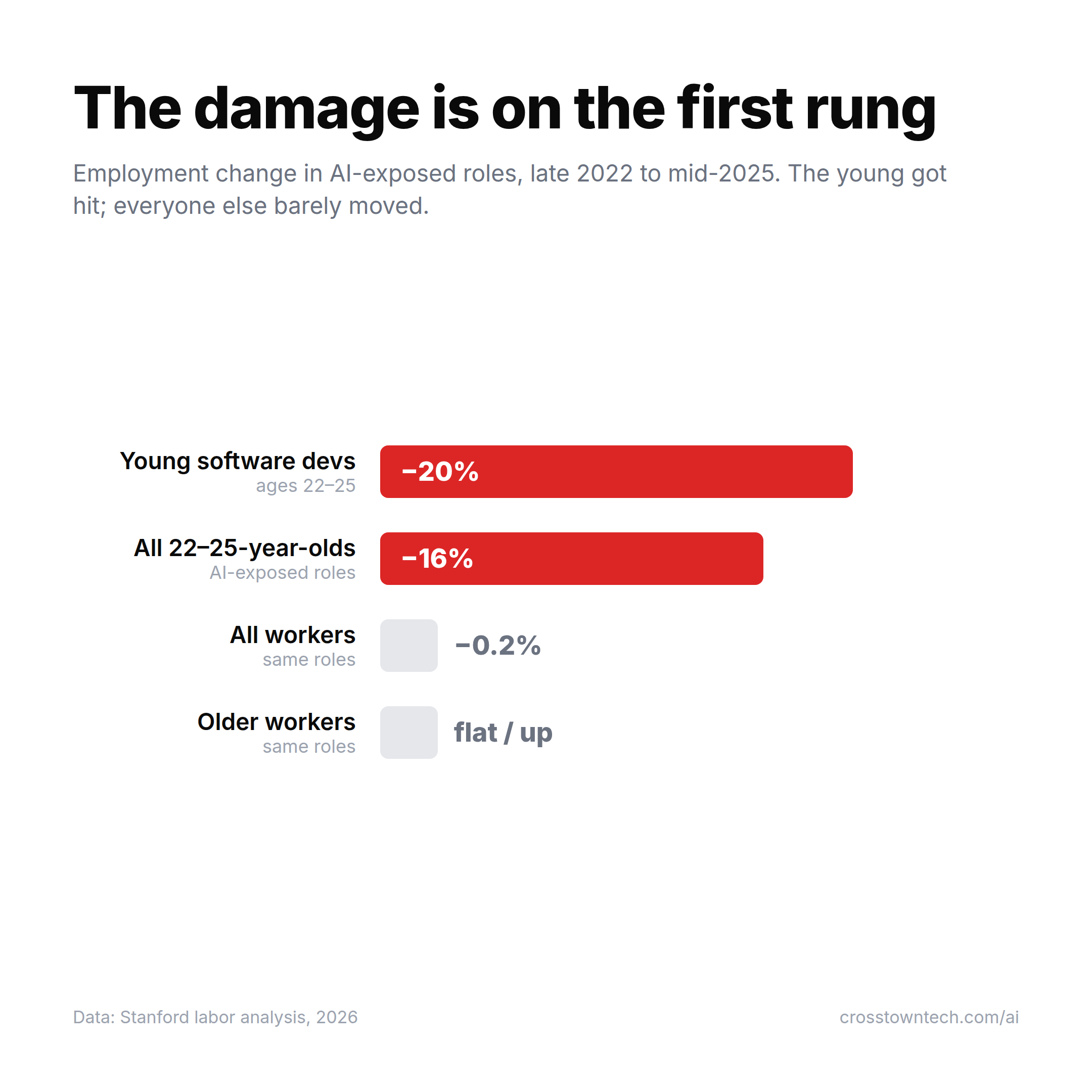
Among 22–25-year-olds in AI-exposed roles, employment fell about 16% from late 2022 to mid-2025 — and for young software developers specifically, closer to 20%. Meanwhile, for all workers in those same roles, employment barely moved (−0.2%), and older workers held flat or grew (Digital Applied). AI is best at exactly the work you used to hand a junior to learn on. So the ladder loses its bottom rung: no first job in the field means no path to the second, and a few years from now the mid-level talent that pipeline was supposed to produce simply isn’t there. Cutting the entry level looks like efficiency this quarter and shows up as a hiring crisis in three years.
What to do with this
Don’t manage to the headline. If you’re cutting, ask which 40% the AI can’t do before you decide the role is gone — that’s the part you’ll pay to rehire. If you’re hiring, the entry level is on sale precisely because everyone believes the apocalypse story; the firms still building a junior pipeline will own the mid-level market nobody else can staff in 2029. And if you’re early in your career, the move isn’t to out-type the model — it’s to get fast at the judgment it can’t do, on the smallest team that’ll still take a bet on a first rung.
The jobs apocalypse got called off. The quiet reshaping of who gets a start did not.