
Someone on r/ClaudeAI was about to switch models. Claude had “gotten dumber” — vaguer answers, ignoring rules, drifting halfway through a task. Before they left, they deleted half their CLAUDE.md file. The model came back. The docs they’d written to help it were the thing dragging it down.
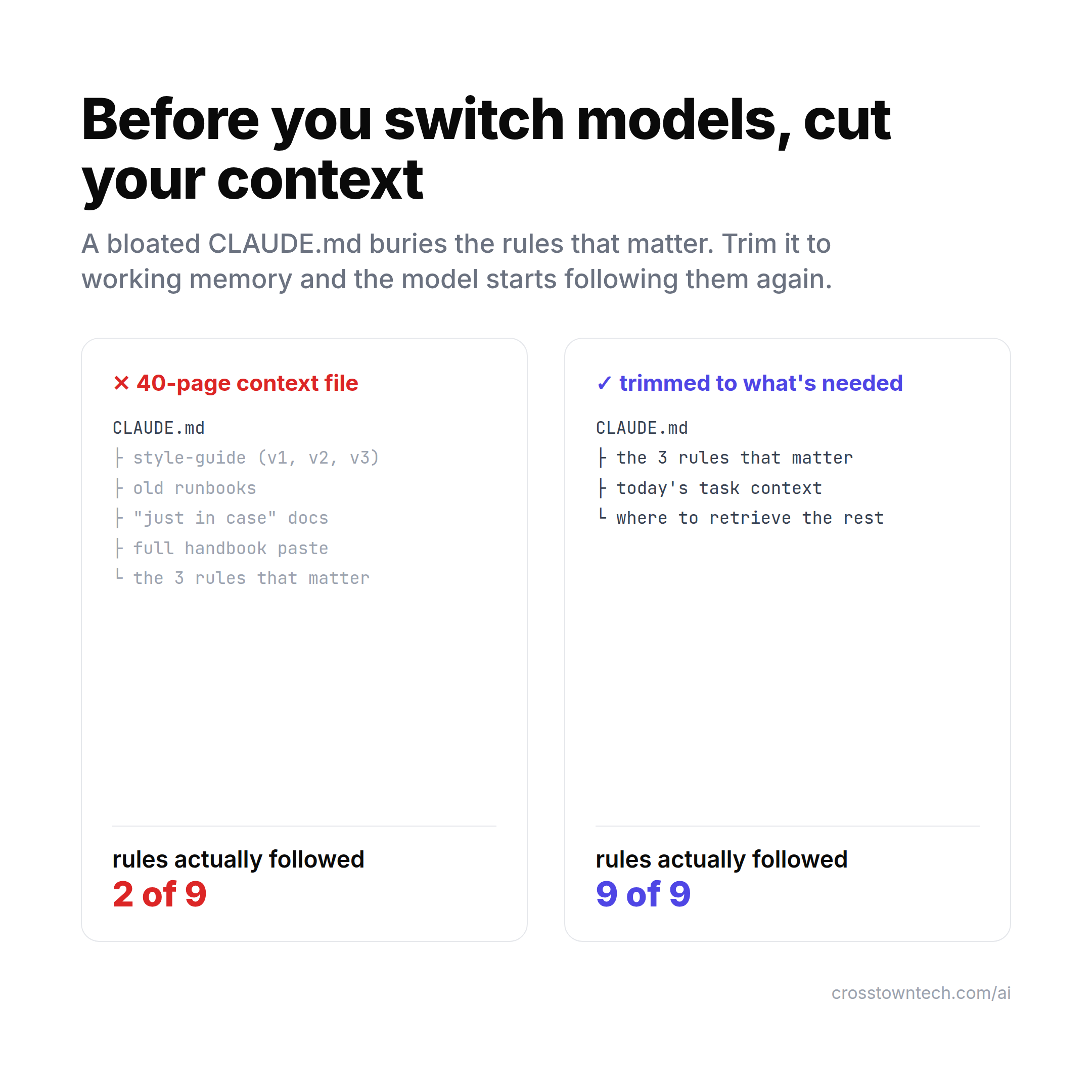
That’s the part almost nobody tells you. When your AI gets worse deep into a task, the instinct is to blame the model and go shopping for a better one. But the culprit is usually the pile of context you keep feeding it — the bloated instructions file, the pasted style guide, the “just in case” docs folder, the whole knowledge base stuffed into the prompt.
Why does the model get worse the more you tell it?
Because reasoning degrades with input length — long before the window is full. Chroma tested 18 frontier models (GPT-4.1, Claude 4, Gemini 2.5, Qwen3) and every single one lost accuracy as context grew, with retrieval dropping 20–50% between ~10K and 100K+ tokens (Chroma, Context Rot, 2025). A model advertised at 200K tokens can start slipping around 50K.
More context isn’t more help. Past a point, it’s more noise the model has to wade through — and it wades badly. This is the same thing I argued about model choice in “you wouldn’t notice if we swapped your model”: the model was rarely your bottleneck. Your pipework is.
Aren’t my own docs the good kind of context?
No — and this is the twist that should change how you think about it. Coherent, on-topic text degrades a model’s attention more than random junk does. In Chroma’s tests, semantically similar distractors hurt worse than shuffled ones — because they look relevant, so the model keeps weighing them (Chroma, 2025).
Your well-written company handbook is the perfect distractor. It’s on-topic, it’s tidy, and it pulls attention away from the one instruction that actually mattered for this task. Add the “lost in the middle” effect — models attend to the start and end of a long context and skim the middle, with accuracy sagging 30+ points for facts stranded in between (Redis, 2026) — and the rule you cared most about is exactly where it gets buried.
How do I know it’s my context and not the model?
There are tells. It starts sharp and drifts as the session runs. It ignores explicit rules you know you wrote down. And it gets agreeable — asking fewer questions, making more assumptions, skipping the verification it used to do. A drowned model doesn’t announce it’s drowning; it just quietly guesses more.
Even the model makers see this. Anthropic’s own postmortem traced a stretch of Claude “getting worse” partly to changes in its harness and operating instructions — not the weights (VentureBeat, 2026). If the people who built the model can degrade it with instructions, so can you. The clean test: trim the context and re-run. If it snaps back, it was never the model.
How to audit what you feed the model this week
Five steps, no new tools:
- Measure a baseline. Pick one real task the model does often and note how well it does it right now. You need a before to see the after.
- Cut the context in half. Open your biggest instructions file — CLAUDE.md, the system prompt, the pasted handbook — and delete the stale, the duplicated, and the “just in case.” If a rule hasn’t earned its place this week, it goes.
- Treat that file as working memory, not a wiki. The common mistake is dumping everything in, including the rules that then get lost. If the model keeps breaking a rule you wrote down, the file is probably too long (Towards Data Science, 2026).
- Retrieve the slice, don’t paste the library. Pull the relevant chunk in for the task at hand instead of loading everything up front. This is the whole point of The Context Stack — retrieval beats volume, every time.
- Re-measure. Run the baseline task again. Nine times out of ten it’s sharper on less.
Before you switch, cut
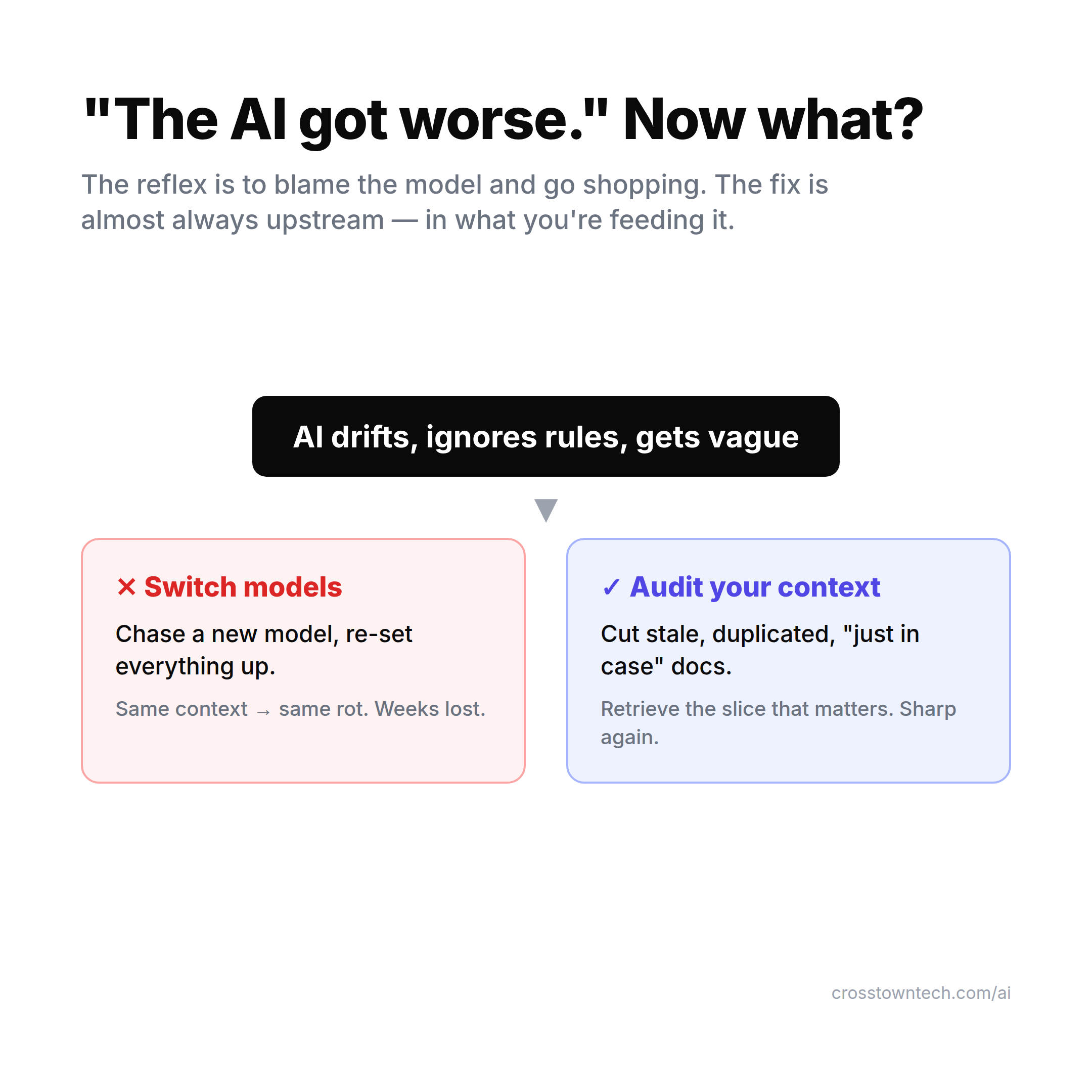
The reflex — new model, fresh setup, hope it’s better — usually just carries the same bloated context into a new home and gets the same rot, a few weeks later. The cheaper move is upstream.
So before you switch models, open your biggest context file and delete everything the model doesn’t need for this task. Then run it again. The fix was never a better model. It was less of your own noise.
FAQ
Can too much context make an AI model worse? Yes. All 18 frontier models Chroma tested in 2025 lost accuracy as input grew — 20–50% between ~10K and 100K+ tokens — well before their advertised context limit. More context past a point degrades reasoning rather than helping it.
Why do my own documents hurt the model more than random text? Because coherent, on-topic text looks relevant, so the model keeps attending to it. Chroma found semantically similar distractors degrade performance more than shuffled, random ones. A tidy company handbook is an effective distractor precisely because it reads as useful.
How do I know if the problem is my context or the model? Trim the context and re-run the same task. If quality snaps back, it was the context. Common tells that it’s context rot, not the model: the AI starts strong and drifts, ignores rules you explicitly wrote, and gets more agreeable (fewer questions, more assumptions) as the session grows.
I write one of these a week on making AI actually work inside real companies — the unglamorous context-and-workflow stuff, not the hype.