
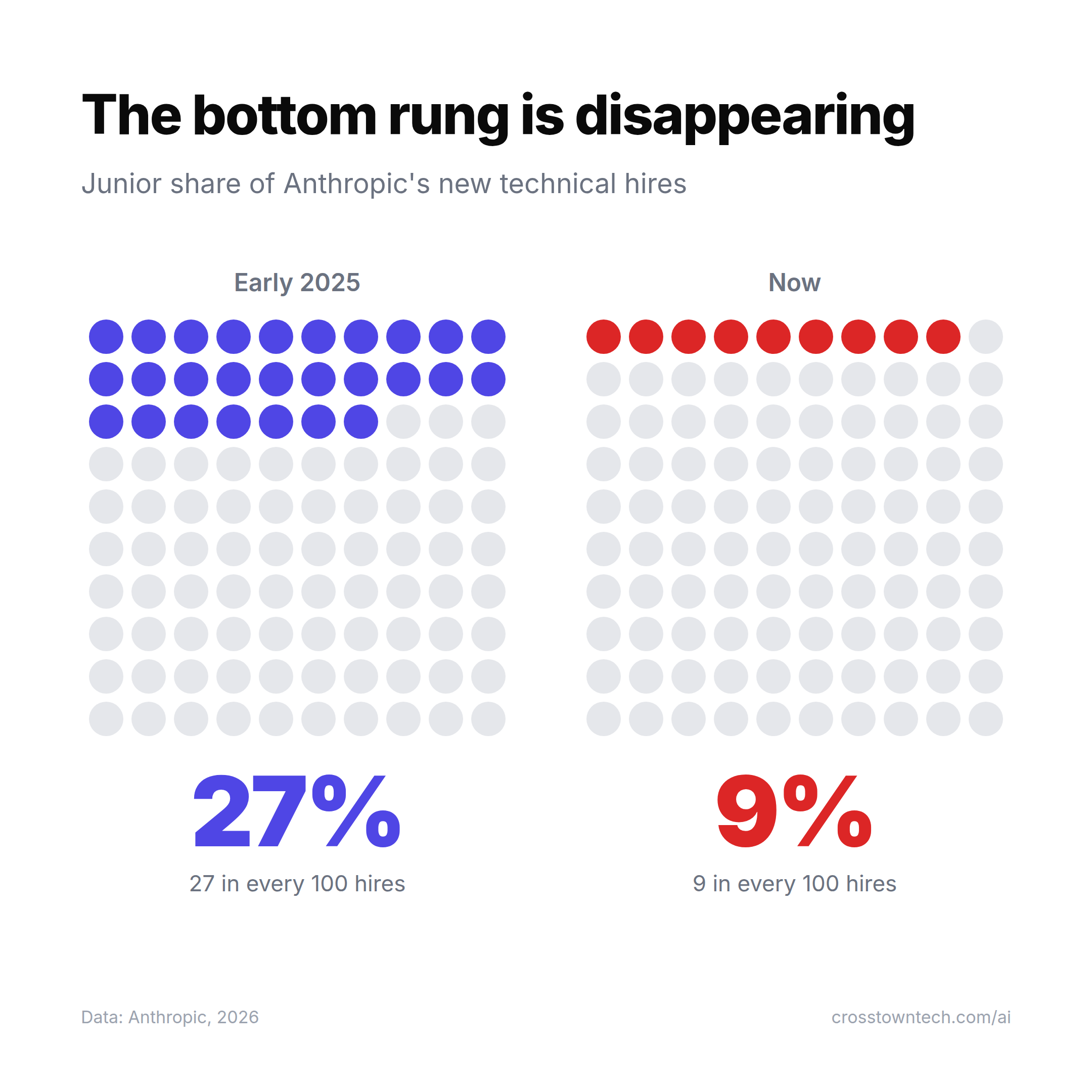
Anthropic now hires far fewer junior engineers. Junior hires fell from 27% to 9% of its new technical hires since early 2025, according to the company’s own employment report published October 16, 2026. In the same period its AI agents grew to log six times the hours of its staff. The question that leaves for every manager: if juniors stop getting hired, who is senior in 2033?
What did Anthropic actually report about junior hiring?
The junior slice of its technical hiring shrank to a third of what it was. The report, written by Anthropic’s economics team, gives these numbers:
- Junior share of new technical hires: 27% → 9% since early 2025.
- Junior share of technical staff: 21% → 14% over the same period.
- Junior postings fell sharply after December 2025. The Decoder reads the open junior roles at 6%.
- In an April 2026 survey, around a third of ML managers and a fifth of software engineering managers said they hire less because of AI.
Two caveats matter. These are shares: technical hiring kept growing in absolute numbers. And the authors call the pattern descriptive, adding: “There are many parts of Anthropic’s employment practices that cannot be replicated across the economy.” Read it as the frontier case, the place where the trend shows up first.
Is it just Anthropic, or is junior hiring falling everywhere?
It’s everywhere in tech, and Anthropic is just the sharpest data point. SignalFire’s 2026 State of Talent report (June 2026) found new-grad hiring down about 65% at 12 big tech companies and about 76% at early-stage startups compared with 2019. Engineering hiring overall fell only 11%. The cut landed on the bottom of the ladder.
Stanford’s Digital Economy Lab sees the same shape in payroll data. In its August 2026 update, employment for 22–25-year-olds in highly AI-exposed jobs sits about 19% below where it would be had it kept pace with less-exposed peers, up from 15% a year earlier. Experienced workers show no comparable gap.
The headline labour market looks calm, which I covered in AI and jobs: the boomerang and the entry-level squeeze. The squeeze is concentrated at the entry point.
Why does cutting junior hires look like the right call?
Because the agents now do the work juniors used to be hired for. At Anthropic, interactive agent hours outnumbered employee hours six to one by August 2026, per the report. The Decoder puts research departments at 19 to one. The report also notes junior hiring slowed most in jobs where Claude takes on the most complex tasks.
What’s left for a human is judgment. Anthropic’s hiring managers “increasingly focus on applicants’ autonomy and judgment, rather than execution and narrow expertise.” Co-founder Jack Clark said in June that the company hires more experienced people because “the returns on intuition are much greater than before” (The Decoder).
For one team, this math works. A senior with agents ships more than a senior plus a junior, and nobody has to teach anyone.
Who is senior in 2033?
Whoever got hired as a junior around now, and fewer of them are getting hired. Senior engineers come from one place: years of doing junior work, getting it wrong, and having someone better explain why. SignalFire warns that skipping that step creates “a structural leadership and talent crisis five to ten years down the road.” Take the middle of that window from 2026 and you land around 2033.
Nolan Lovett, in a July 2026 paper he calls “The Tragedy of the Cognitive Commons,” explains why no single company fixes this alone. The firm that cuts its junior line keeps all of the savings. The missing expertise is spread across every company that later tries to hire seniors from the same pool. He expects the effects of entry-level cuts that began in 2023 to surface somewhere between 2030 and 2045, long after the budget decision that caused them.
It’s a classic commons problem. Every company acts rationally, and together they run the pipeline dry.
Who checks the agents’ work if nobody learned the job?
That’s the part that should worry a manager most. Checking AI output takes the same deep knowledge the junior years used to build. Lovett calls this the “validation tether”: the more work you hand to agents, the more you depend on people who could have done it themselves, and the fewer of those people you are producing.
You can already see the early version inside today’s teams. AI raised the floor of output and lowered the floor of understanding, which I wrote about in The Junior Dunning-Kruger. That piece is about skill fading in people already on the team. This one is upstream of it: the people who would have become your reviewers never get hired.
An agent running six times your team’s hours needs someone senior enough to say “this is wrong.” In 2033, that person has to come from somewhere.
What should a manager do with their own junior hiring?
Treat a small junior line as an investment in future reviewers, and redesign the junior job around checking the agents. Five concrete moves:
- Keep juniors on purpose. Decide the number, write it into the plan, and defend it in the AI-savings conversation. The return is your senior bench five years from now.
- Give juniors the checking work. Reviewing agent pull requests, writing tests, running evals, fixing AI-assisted workflows. SignalFire recommends exactly this: models “where junior talent manages, tests, and improves AI-assisted workflows.”
- Let them do some of the work by hand first. Lovett recommends phased AI introduction and learning environments without AI, so the knowledge forms before the shortcut arrives.
- Pair every junior with a senior who reviews their reviews. Judgment gets taught through someone explaining why your “looks fine” was wrong.
- Track your junior share of hires. Anthropic measured and published its own. Put yours next to your AI rollout numbers, so the trade-off is a decision someone signs off on.
FAQ
Did Anthropic stop hiring junior engineers? Close to it, as a share. Anthropic’s October 2026 employment report says junior hires fell from 27% to 9% of its new technical hires since early 2025, and the junior share of technical staff fell from 21% to 14%. Technical hiring still grew in absolute terms, so this is a smaller slice of a growing pie. The report calls the pattern descriptive and says Anthropic is an unusual employer.
Why are companies hiring fewer junior engineers? Because AI agents now do much of the work juniors used to learn on. At Anthropic, interactive agent hours outnumbered employee hours six to one by August 2026, and junior hiring slowed most in jobs where Claude handles the hardest tasks. Co-founder Jack Clark said the company hires more experienced people because “the returns on intuition are much greater than before.”
Is the drop in junior hiring just an Anthropic thing? No. SignalFire’s 2026 State of Talent report found new-grad hiring down about 65% at 12 big tech companies and about 76% at early-stage startups compared with 2019. Stanford’s August 2026 update found employment for 22–25-year-olds in highly AI-exposed jobs about 19% below where it would be had it kept pace with less-exposed peers.
What happens if companies stop training junior engineers? The shortage shows up years later, as a lack of senior people. SignalFire warns of “a structural leadership and talent crisis five to ten years down the road.” Researcher Nolan Lovett argues each company keeps the savings while the lost expertise is shared by everyone hiring from the same pool, and that the effects of entry-level cuts that began in 2023 may not fully show until 2030–2045.
What should managers do about junior hiring while rolling out AI? Keep a small junior line on purpose and change what juniors do. Give them the checking work: reviewing agent output, writing tests, running and fixing AI-assisted workflows, which is what SignalFire recommends. Track the junior share of your hires next to your AI rollout numbers, so the trade-off is a decision someone makes.
Pull one number before your next AI rollout review: what share of last year’s hires were junior, and what is it this year? If it dropped and nobody decided that, you have your agenda item.
I write one of these a week on making AI actually work inside companies.